
Messerschmitt Bf110 Eduard
The first pages of history for the famous Zerstörer Bf 110 were written at the end of 1934, when C-Amt RLM (the technical branch of the Reich’s Air Ministry) issued a specification for a two seat, twin engined aircraft to fulfill a need within the Kamfzerstörer category. Submitted proposals came from Focke-Wulf (Fw 57), Henshel (Hs 124) and BFW (Messerschmitt Bf 110). In the spring of 1935, the RLM changed its thinking on the spec, and cancelled the universal Kamfzerstörer category in favor of two specific types, the Schnellbomber and the Zerstörer. The new concept of a heavy fighter of the RLM were best satisfied by the Messerschmitt design, which wasn’t really dictated as much by the original specifications. The first prototype, the Bf 110 V1, first flew May 12, 1936, and the modified second prototype V2 was submitted to the Erprobungstelle in Rechlin on January 14, 1937. Four development aircraft, A-01 to A-04, powered by JUMO 210Da engines, were delivered at the beginning of 1938.Aproduction run of 45 Bf 110Bs began in July, powered byJUMO210Ga engines, delivering some 500kW (680hp). At the end of 1938, the production line for the high performance DB 601 finally got going, and these were mounted into the first major Bf 110 version, the Bf 110C. The Bf 110C, as was the case with the Bf 110B, was armed with two MGFF cannon, mounted in the fuselage below the cockpit floor, fourMG17 machine guns mounted in the nose and one rear firingMG15 machine gun manned by the gunner/radio operator. There was a crew of two.
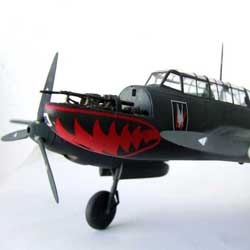 The Luftwaffe received a total of 169 Bf 110Cs by September, 1939. The first combat experience of the type in Norway and France uncovered a small operational radius, unsuitable for an escort fighter. The first attempt to remedy the shortcoming came in the form of a large, under fuselage conformal type external fuel tank, called the Dackelbauch. The Bf 110C-3, adapted to carry this tank, were re-designated D-0. Results were not entirely satisfactory with the D version, and so there was a reconstruction of the fuel system, after which aircraft of the D version carried two drop tanks under the wings, and a small oil tank under the fuselage. The Bf 110D also standardized a longer fuselage, by way of an extension at the rear carrying a life raft and other emergency survival gear. This was a feature also evident on some subsequent Bf 110Es, which were equipped with bomb racks under the fuselage and wings. The majority of Bf 110Es were powered by the DB 601N engines. The following Bf 110F received the DB 601F engines housed in reshaped nacelles, with newer, more rounded spinners, aerodynamic features taken from the Bf 109F. Upgrading efforts were noted in the armament as well, where theMG FF were replaced by MG 151s. Significant changes came with the Bf 110G, powered by new DB 605 engines. The rear firing MG 82Z double gun appeared on the G-2, and with the G-4 came the replacement of four forward firing machine guns with two 30mm MK 108 cannon. The G-4 also saw larger rudders mounted. The Bf 110 went through not only technical changes throughout its career, but also through a development of its operational use. It entered the war as a heavy escort and attack fighter. By the time of the Battle of Britain, it became apparent that the aircraft, in the role of escort fighter, had been pushing the envelope of its capabilities. On the contrary, as a defensive weapon against British bombers, the Bf 110 made an extremely good showing of itself, and remained a deadly foe through to the end of the war. The placement of RAF bombing operations within nighttime hours from 1941 brought the Bf 110 into the realm of night fighting on the Western Front. On the Eastern Front, they excelled as fast fighter bombers. Their earlier role as a day attack fighter was still fulfilled not only on the Eastern Front (where they were employed throughout the war successfully even as the originally envisioned escort fighter), but also on the Western Front into the depths of the summer of 1944, where the role was abandoned primarily, and finally, due to the effectiveness of American fighter escorts.
As a night fighter in the G-4 version, thanks to a heavy forward firing armament and radar, they soldiered on literally until the very end of the war. As such, it was the night fighter role that would prove to be the most significant for the Bf 110 during the course of the Second World War.
Eduard has released 1/48 scale kit of this airplane in the late summer early autumn 2007 and this was big bang in their releases. All of their products are very quality but this one is larger in size then any other and the same construction of the original airplane give as result very complex model kit. The same kit has over three hundred of parts and from the box is possible to make C or D model. Fuselage has inside two assembly section which has to be included. One is the front nose section which can be display open and feature four machine guns with all systems inside. Other section is the cockpit of course and it have top detailed compartment for the three crew.


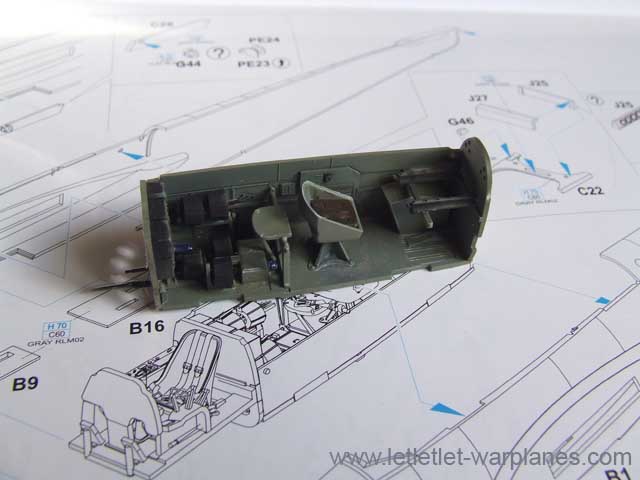

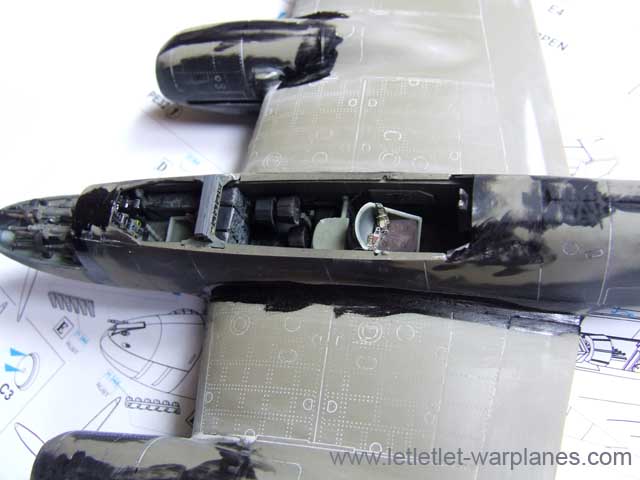


Wings are also complex but not as the fuselage. It house engines in the front and they are made from several parts. Also on the bottom is placed radiators which is present perfectly thanks to the photo etched parts. Most sensitive section is the landing gear. No need to say that this is very detailed section and parts consisted landing gear is very tiny so much care have to be taken during the manipulation.
As you have noted the kit have photo etched parts in the box. Also to note that transparent parts are most detailed manufactured and several parts need photo etched parts before join to other parts. It feature option for closed or open cockpit.
As usual for the Eduard assembly sheet is not assembly sheet at all but very detailed booklet in full color and A4 form. Last pages includes camouflage and markings for several airplanes and decal provided with kit are of excellent quality.
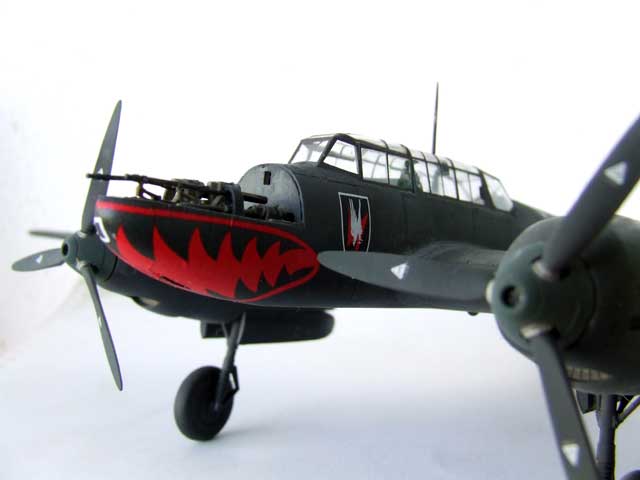
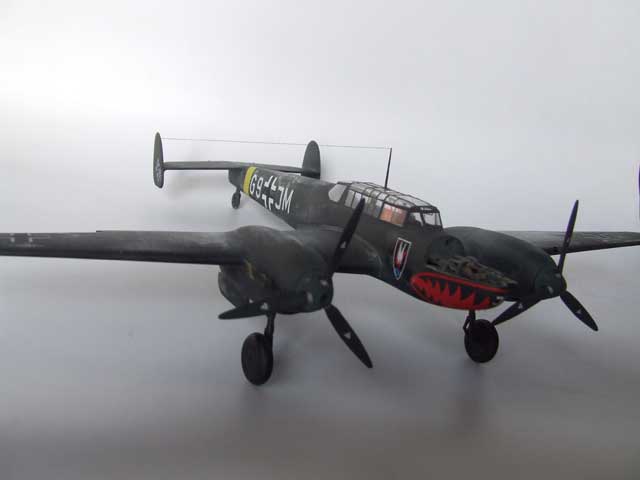
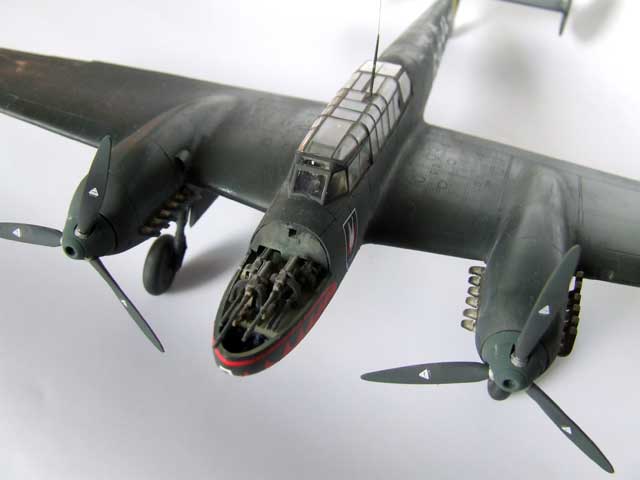
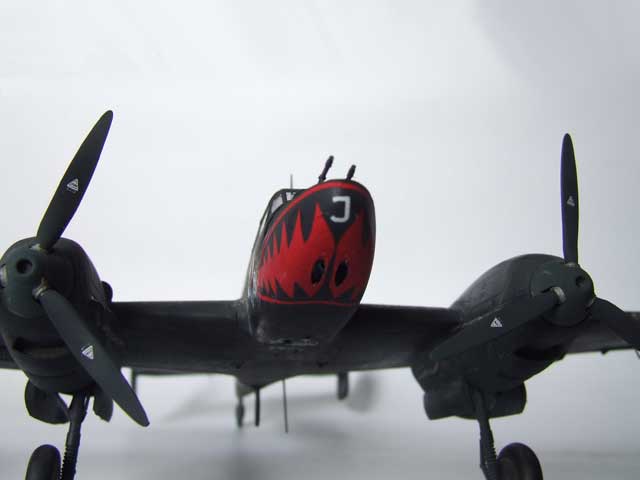

One of the best Eduard kit ever made!! Very detailed and with many build options. But it is the complex kit and definitely is not for beginners. Highly recommended!!
Srecko Bradic
Sample kit is provided by Jana Sulcova from Eduard.
Screcko. This is an unsual request, BUT if you can help it will very much apprecaiated.
The BF 110, I need a complete photograph of the inside of a BF110, ESPECIALLY WHERE THE FUEL TRANSFER VALVE IS SITUATED.
dO YOU HAVE ANY IDEA —
Kindest regards
Jim
Dear Jim,
please contact me on my email srecko.warplane@gmail.com and I will see what I have in my files.
Cheers 🙂