
Saunders Roe SR.53 and 177
In the mid-fifties the British aircraft industry produced a number of operational jet fighters with trans-sonic capabilities like the Hawker Hunter, Gloster Javelin, De Havilland Sea-Vixen and the Vickers-Supermarine Scimitar. During this time, a new generation of supersonic fighters and fighter-bombers was being developed with a number of various prototypes in advanced stages.
 Some of them were actually built and flown before the notorious ‘White Paper’ was released by the British Tory government. This document effectively killed all projects except for the English Electric Lightning, which was regarded as the ‘last manned fighter’ of both the RAF and Navy. In fact, this also meant that the whole British aircraft industry missed many chances for production orders to other countries! In this article, we shall discuss one of these projects that actually resulted in a flying prototype: the Saunders Roe SR.53 mixed-power interceptor. Also, we shall have a closer look at the never-built SR.177. Particularly the SR.177 which was a very promising design since it lacked the disadvantages of low power and short range of the SR.53…………
Development of the SR.53
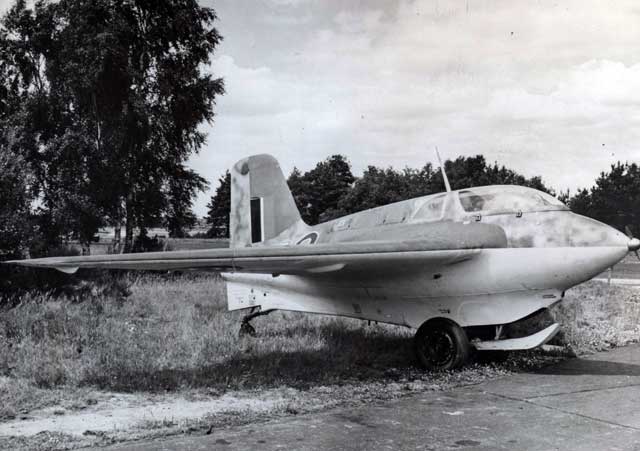
With a captured German Me-163 Komet rocket fighter as an example, British aircraft engineers in the late forties/early fifties started on several projects of a similar point defence fighter. The major drawbacks of the Me-163 were that it could only use its excess of speed for a very short period of time to execute a bomber interception and once that its rocket fuel was exhausted, it was nothing more than a glider and after landing, it had to be towed away making it very vulnerable during an enemy air attack. For a more sustainable flight, British designers (and also designers from a number of various other countries) came up with the concept of the mixed-propulsion jet fighter. It could cruise on a jet engine and once it had to make an interception the rocket engine was ignited. This gave the plane a tremendous rate of climb combined with a very high -supersonic- speed. Also Saunders Roe Ltd, based at Cowes on the Isle of Wight, designed such a mixed-propulsion fighter: the SR.53.
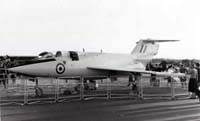
 Designed by Maurice Brennan, the chief designer at Saunders Roe, the SR.53 was a designed in 1953 to meet Specification F.138D for an interceptor with mixed propulsion. Their SR.53 showed a fighter with knotted delta wings in combination with a sleek fuselage with two small air intakes for the jet engine behind the cockpit. The all-movable type horizontal tailfin was placed on top of the vertical stabilizer. On both wingtips air-to-air missiles could be carried. However, there was no provision for internal cannon armament.
The main propulsion of the SR.53 was supplied by a De Havilland Spectre rocket engine. For interceptions, within 3.5 minutes at 18.000 m, the aircraft could reach mach 2, twice the speed of sound. After completion of its mission, it would return to its home-base using a low-power jet engine. The rocket engine consumed a mixture of stabilized hydrogen peroxide (HTP) and kerosene.
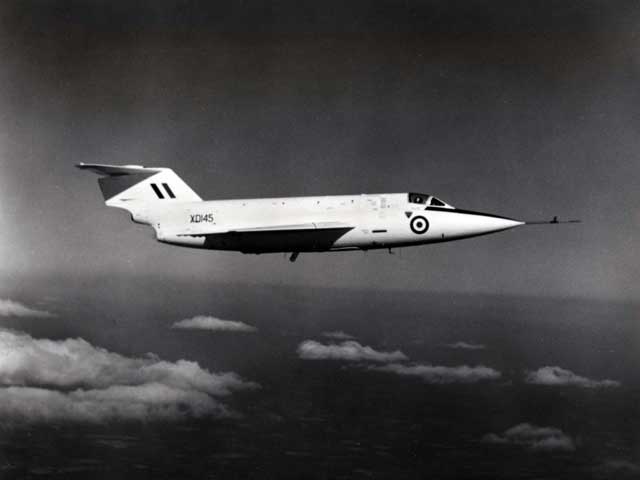
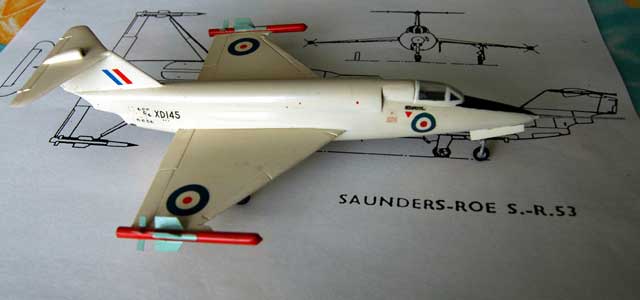
Initially three prototypes of the SR.53 were ordered; however, eventually only two were actually built and flown carrying the military serial numbers XD145 and XD151.
Flight testing program
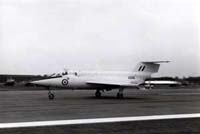
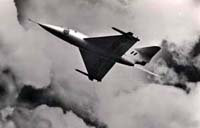 The XD145 was completed in the Saunders Roe works at Cowes on the Isle of Wight in 1956. From here it was transported by barge to the mainland and then transported by road to Boscombe Down test centre. It was from here on 16th May 1957 it made its first flight with test pilot John Booth at the controls. However, within the same year also saw the publication of the infamous ‘White Paper’ from Duncan Sandys the then Minister of Defense. In this document the development of various very promising fighter aircraft were terminated in favor of the further development and production of the English Electric Lightning. According to the ‘White Paper’ the Lighting would be the last British jet fighter ever and after its retirement in the future it would be replaced by guided missiles.
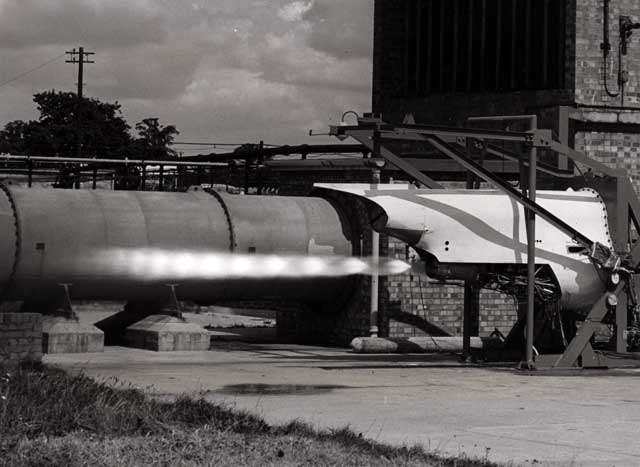
In spite of this, limited test flying with the SR.53 was conducted until October 1957 when it was slightly damaged during a ground run when the rocket engine fired back. After this, it was only used for ground-run tests with various other types of rocket engines. The second SR.53, XD151, had a very short career. It was exhibited in 1957 before its first flight at the SBAC airs-how at Farnborough. It made its first flight on 8 December 1957. It crashed on its 12th flight on 5th June 1958 shortly after take off. The exact reason was never clear, but it was a known fact the Viper jet engine was giving insufficient thrust during take off and that the SR.53 needed further augmentation from the rocket engine. Apparently the rocket shutdown during take off and the plane hit a pylon at the end of the runway. It exploded and John Booth was tragically killed.
In total only 56 flights were made with both prototypes totalling 22 hours and 20 minutes. XD145 made 31 flights before the crash of XD151 and another 14 flights after the crash. During the flight trials, the SR.53 behaved generally as expected without any unpleasant flight characteristics.
Further developments
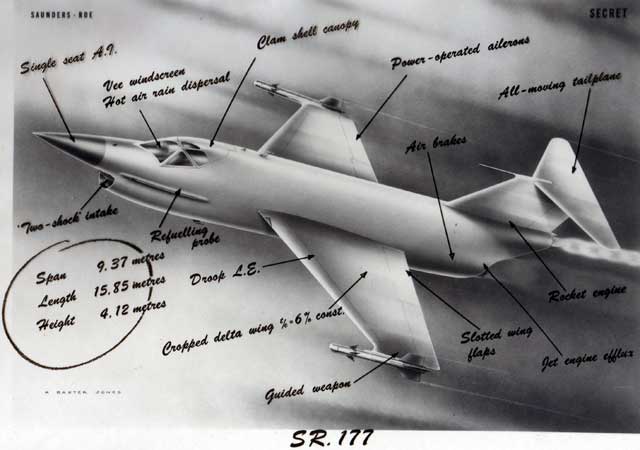
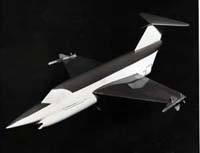
 In fact the low-powered SR.53 was nothing more than a proof-of-concept aircraft, demonstrating that the combination could fly. With the low-thrust Viper jet engine the SR.53 was definitely not suited for its intended role as an interceptor, cruising around on its jet engine until interception at full rocket power. Saunders Roe had developed for this purpose a new type with a much more powerful jet engine. This project received the designation SR.177. The SR.177 was larger and heavier than the SR.53. In fact the all-up weight was twice of that of the SR.53. It was designed to be fitted with a De Havilland Gyron Junior jet engine offering a thrust of 6350 kg with full afterburning, which was almost eight times the thrust of the SR.53’s Viper! The planned rocket engine was only for the pure interceptor version. Two other variants of the SR.177 were planned, a light ground attack version and a photographic reconnaissance version. For these two variants the rocket engine was not necessary and as such the engine would be removed.
However, the SR.177 was also a victim of the ‘White Paper’ and only a technical inspection mock-up was produced. Saunders Roe also designed the SR.177 to be fitted with an arrester hook for the Royal Navy use. They further tried to find customers outside the UK. Germany was highly interested in the SR.177 both as interceptor and as ground-attack fighter/reconnaissance aircraft, but with no orders coming for the Royal Navy, this end for this promising project was soon in sight.
 The rest is now history; Germany ordered the F-104G as standard interceptor and the Fiat G-91 as fighter bomber/reconnaissance plane!
Another projected SR.53 development was intended to be carried in-flight by a Vulcan bomber. Only fitted with a rocket engine with the jet engine replaced by additional fuel it had a range of 145 km. After completion of the combat mission the pilot had the choice between either baling-out via the ejector seat or flying the plane as a glider to the nearest airstrip!
Museum piece
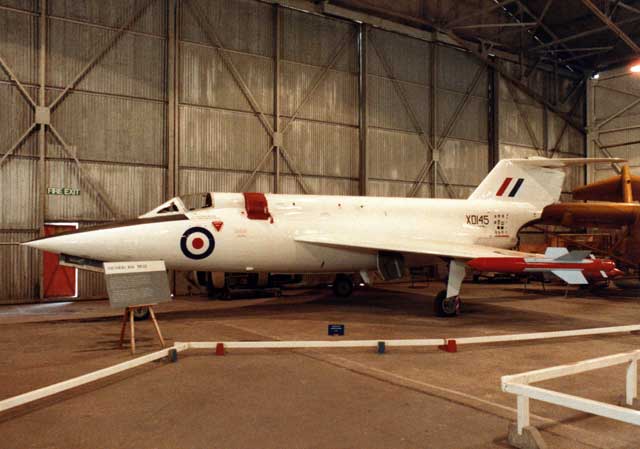
After flight and ground run testing was terminated, the single SR.53 XD145 was transferred to the RAF Museum storage facility at Henlow. In remained there until 1978 when it was donated to the Brize Norton Aviation Society. Here it was restored into static conditions for final display in the RAF Museum at Cosford. It was officially handed over on 30 November 1981 and can still be seen in this very nice aviation museum!
Technical details SR.53
Power plant:
Armstrong Siddeley A.S.V.8 Viper 101 jet engine of 795 kg thrust
De Havilland D.Spe.1a Spectre single-chamber rocket motor of 3630 kg thrust
Dimensions:
wing span 7.65 m (without dummy missiles)
length 14.53 m including nose probe; fuselage length 11.92 m
height 3.30 m
wing area 25.20 m2
Weight:
empty 3016 kg
loaded weight 8346 kg (max. 9180 kg)
Performances:
max.speed Mach 2.1 at18.288 m on both engines
306-324 km/h on turbojet only
service ceiling 18.000-24.000 m on both engines; 3050 m on turbojet with rocket fuel exhausted range endurance ca 50 minutes with 5 minutes operating time of the rocket motor
Armament:
two wingtip mounted Firestreak air-to-air guided missiles
Exctract from the manual- click to download zip file
Technical details SR.177 (from Saunders Roe Publication TP.271):
 Power plant:
De Havilland P.S. 50 Gyron Junior jet engine of 6350 kg thrust with afterburner
De Havilland D.Spe.5 Spectre single-chamber rocket motor of 3630 kg thrust
Dimensions:
wing span 9.37 m (without guided weapons fitted on the wingtips)
length 15.85 m (fuselage length 15.10 m)
height 4.12 m
wing area 30.0 m2
Weight:
empty 6620 kg
loaded weight 12.620 kg (all-up weight with maximum internal fuel)
Performances:
max. speed Mach 2.3 level speed on both engines
Mach 0.97 on turbojet only
service ceiling 24.000 m on both engines;
range 2620 km (ferry range for variant without rocket engine.
The operational version of the SR.177 had provision for in-flight refuelling.
Armament:
Fitted with two wingtip mounted air-to-air guided missiles or wingtip mounted unguided rocket batteries. For ground attack missions various under-wing stores of bombs and rockets could be carried. For photo reconnaissance missions a belly mounted camera pack was planned.
Tips for the model builders:
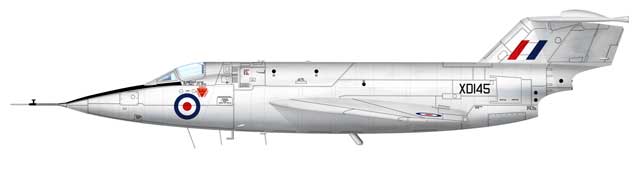
Airfix launched in the early sixties a 1/72 scale model kit of the SR.53 of general good quality, although not up to present-day standards. It was packed in a simple bag with decals for XD145.
References:
-Anonymous, S.R. 177 mixed unit aircraft, Publication no. TP.271 of August 1957 Saunders Roe Publication Dept.
-Bill Gunston, SR.53 and SR.177-The Saunders Roe jet/rocket interceptors, Aeroplane Monthly, July 1974
-Barry Hygate, British experimental jet aircraft, Argus Books UK (1990)
-Barry Jones, Saro’s mixed-power saga, Aeroplane Monthly, November 1994
Note: interested in a pdf-file of the full Saunders Roe Publication TP.271? Contact Webmaster for this rare 70 page document!
Nico Braas



Great web pages. I am a bit of an aircraft freak and regret the passing of a great UK aircraft building industry. Living close to the isle of wight I also remeber the days of the Princess flying boat and the Empire flying boats that used to fly from Calshot.
Hello Nico
I wonder if you can help me.
I play a game that uses all sorts of transport.
One form that is currently under consideration for introduction into the game is Flying boats. A moddeler who designs planes needs has been approached by me to make a graphic model of the SR Princess flying boat.
He requests basic dimensions.
This is to eneble him to design a scaled down model of it.
The finished view of the Aircraft is a maximum of 250 PIXELS in size!.
So the dimensions are simply the overal length, wingspan, under_carraige (hull) tail hieghts, engine size and spacing’s etc necessary to present a reaonable image to the screen. The execcutable program has built in variable values that refer to sprite sizes (graphics).
So if you have any information that I can pass directly to my moddleing friend (A Russian player of the game) that would be great.
The game is called locomotion by Chris Sawyer and published by Atari since 2004.
Thank you
Brian