
Werner Voss: Hero or Super Hero
In the distance, you hear the wispy sound of a rotary motor in the early morning hours of 23 Sept 1917. The engine sound starts off very faint, in the distance at first, then gathers with intensity as it nears the airfield. At first you search the skies for where the sound is coming from, then moments later, your eyes adjust to the early morning light and you see a small dot in the distance. That dot grows larger and larger with every passing moment until the silhouette of a lone Fokker triplane can be positively identified. You hear the perfect manipulation of the throttle – as its speed, increasing and decreasing, allows the aircraft to lose altitude gracefully. Yet, it appears that the pilot of this craft has it perfectly aligned with the turf that it will eventually land on. As the aircraft nears the field you see a perfect glide to descend ratio, everything aligned for another superb landing by its young pilot.
Just when you think that the aircraft will land at any moment, the pilot gives his aircraft full throttle andJust when you think that the aircraft will land at any moment, the pilot gives his aircraft full throttle and climbs for the sky. Up he goes toward heaven and with superb grace; he pulls the aircrafts control column to his chest and releases it slowly forward. At the correct moment the aircraft gracefully rolls over into a nice tight loop over the field. This type of manoeuvre indicates to those below on the ground that the pilot has claimed another victory over the British. The ground crew and pilots that happen to be in the area applaud the Fokker’s performance of its victory roll over the shared airfields of Jagdstaffeln (hunter squadrons, abbreviated Jasta) 4, 10, 11. This field also happens to be the Headquarters of Jagdgeschwader (hunting group, abbreviated JG) I at Marckebeeke, Belgium.
Of course, according to the Commander of JG I, Rittmeister Baron Manfred Freiherr von Richthofen, this sort of aerial exhibition was absolutely forbidden in his Doctrine of airfield conduct: Richthofen’s Air Combat Operations Manual: Nr. 42360. Fl. II. Just because this pilot happened to be the Commander of Jasta 10, was no excuse, and he knows it. But while the cat is away; Von Richthofen was on leave at that very moment in time, hunting in the Thuringia Forest as the guest of the Duke of Saxe-Coburg-Gotha – the mice may play.
You watch as the Fokker triplane gracefully glides down to earth knowing that this pilot will expertly guide his aircraft towards a perfect landing. These new F.I model Fokker triplanes, as well as the future Dr.I models, had a tendency to yaw to the right. If the pilot didn’t pay special attention to the controls at all times, he could wind up doing a cartwheel into the soft turf of the airfield, spoiling a perfectly good day.
The triplane bounces once, maybe twice as it rolls to a stop near the tent hangers. The pilot’s ground crews, already on the field, help him manoeuvre his aircraft around. He assists them by applying power to his engine or retarding it as the case may be. Pilot and ground crew are intent on reducing the time required to service the aircraft so that it is ready for combat at a moments notice.
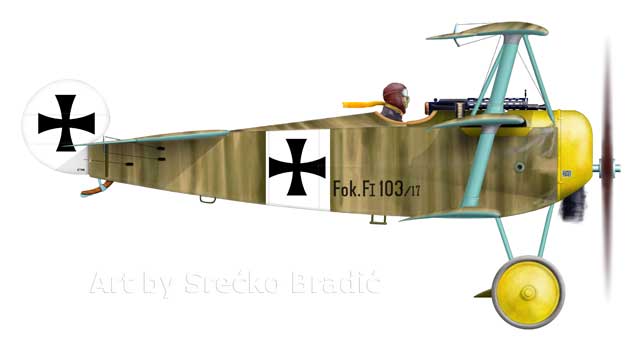
Once the rotary engine comes to a complete and sudden stop, the ground crew automatically chocks the wheels of his aircraft and the pilot removes his helmet and goggles in one swift motion. He sits in the cockpit of his Fokker F.I 103/17 for a moment, clearing both guns by pushing the charging handle forward, then back into its original position. Satisfied that his guns are clear, he unbuckles his seat-belt and starts to climb out of his machine. His ground crew is available to assist him down if needed.
He begins to discuss the Fokker’s engine performance with his motor mechanic Gefreiter (Lance Corporal) Karl Timm. Later while walking towards the Operations/ Administrative shack with his airframe mechanic Gefreiter Christian Rüser, he mentions the extra holes his aircraft might have picked up while he was claimed his 48th victory.
The pilot was a tall, slim fellow who walked with steady, confident strides; dressed only in an old grimy grey sweater, striped grey pants and high laced up leather boots.
As he entered the Operations building, he is met by his administrative officer Oberleutnant (Oblt) Ernst Weigand. He is handed a combat report to fill out. Oblt Weigand then returns to his normal duties, after a note of congratulations to the pilot for his latest victory. Leutnant der Reserve (Ltn d.R.) Friedrich Rüdenberg happened to be in the office, as the pilot arrived and began to fill out his after actions report.
His mind must have been elsewhere as he filled out the details concerning his victory from the morning’s patrol: Date – 23 Sept 1917, Time – 0930, Aircraft shot down – D.H.4, aircraft number – A7643, location of shoot-down – South of Roulers, and then there was a Freudian slip, maybe an infelicitous or fortuitous omen. On the line reserved for the victim’s name, he inadvertently placed his own name. Realizing his error almost immediately, he took corrective action to eradicate this error on his paperwork. He placed his name in its correct location, signed it and then handed it to the administrative officer for confirmation.
As he departed the administrative office and stepped into the soft turf of the airfield, his recent error might have or might have not shaken him up a bit. No one would ever know, as this day, 23 September 1917, was to be his last day on earth.
Whatever his mood was at that particular moment, it changed dramatically as he was met by his two brothers: Ltn. Otto and Vizefeldwebel (Vzfw – senior noncommissioned officer) Max who were walking towards him and waving. They had arrived at his airfield shortly before he arrived from his sortie and had arranged to have lunch with him that day.
Soup and black bread topped off with coffee and cake with family conversation mixed in lightened his thoughts as they talked. Otto’s conversation centered on his upcoming acceptance into flight school, with hopes that he would follow in his older brother’s footsteps. Max, on the other hand, referred to his time in the trenches and Werner remembered his earlier experiences there and how glad he was glad to get out of them.
Both of his brothers had noticed, as he talked and sipped his coffee, that a change had come over Werner since they saw him last. There were deep, dark circles around and under his eyes. Lines of age showed through his youthful face and it was hard to believe that this young man was barely in his twenties. He talked about how tired he was of the war, he had been at it since 1916, and how eager he was to go back on leave again, even though he had just returned.
After lunch, Werner and his brothers walked the airfield and for a lark, Werner stopped by his quarters and retrieved his camera. Photography had become a hobby shared with his commander and friend Manfred von Richthofen. He decided to take a few pictures of his brothers and include himself.
As they walked, Werner adjusted his camera with the proper settings for the time of day, light and distance. He selected the hanger at Jasta 10 as the perfect backdrop for the pictures he was formulating in his mind.
Werner set up his camera, adjusting the focus for the best possible shot. He used the front portion of a backed in Pfalz D.III as the pictures backdrop and aligned his brothers in their respective photogenic positions. He set the timing device on the camera and immediately got into position between his brothers, with Max on the left and Otto on his right.
Moments later they heard the shutter click. One picture down and one to go, he thought.
He repositioned his brothers again so that now he would be on the left, followed by Otto and then Max. Again he assured that the focus on the camera would be perfect, set the timer, and hustled to his new position.
The camera shutter gave that resounding click sound, and another picture was completed. He collected his camera and once again he and his brothers toured the airfield and talked. Later that day, he said farewell to his brothers as they drove off, not realizing that this was the last time they would ever see each other alive.
At about this time the pilots of Jasta 10 gathered around the operations hut to hear the details about the evening’s combat sortie. It was scheduled to begin at about 1800 hours and would have three Ketten (or flights).
Ltn.d.R Werner Voss flying his Fokker F.I 103/17 would lead the first flight with Ltn.d.R Gustav S. Bellen flying a Pfalz D.III (4169/17) on his right wing and Ltn.d.R Friedrich Rüdenberg flying a Pfalz D.III (1379/17) on his left wing.
Oblt Ernst Weigand would lead the second flight with his Albatros D.Va (5401/17) along with Ltn.d.R Max Kühn, Ltn.d.R Erich Löwenhardt and finally Ltn.d.R Aloys Heldmann. All of these pilots would be flying Pfalz D.III on this patrol.
With the pilots briefed on their evening patrol, they depart to rest up, eat or what ever they needed to do to get prepared for their evening sortie.
The air was crisp and clean, from the recent rain shower as Ltn.d.R Werner Voss’ walked towards his aircraft. He sported a fine non-regulation expensive colored silk shirt underneath his finest military uniform. He wore calf length highly polished boots and a long, brown leather flying coat that stopped just below his knees. In his right hand, he carried his fur and sheep-skin lined flying cap and goggles.
Leutnant Voss hadn’t yet buttoned up his leather coat and it flapped behind him as he walked. About his throat hung one of his most prized possessions: The Pour le Mérite. The medal glimmered in the fading light as he walked and greeted his fellow pilots for the upcoming patrol.
As he approached they nodded an acknowledgement of his presence. He on the other hand nodded back as a form of respect and wishing them good-hunting on the upcoming patrol.
His long, lean strides upon the soft, moist turf generated confidence in his whole presence. Werner was acknowledged by his fellow pilots as being a bit of the common man. He preferred to work right along side the motor and airframe mechanics on his aircraft, to mingling amongst his brother officers.
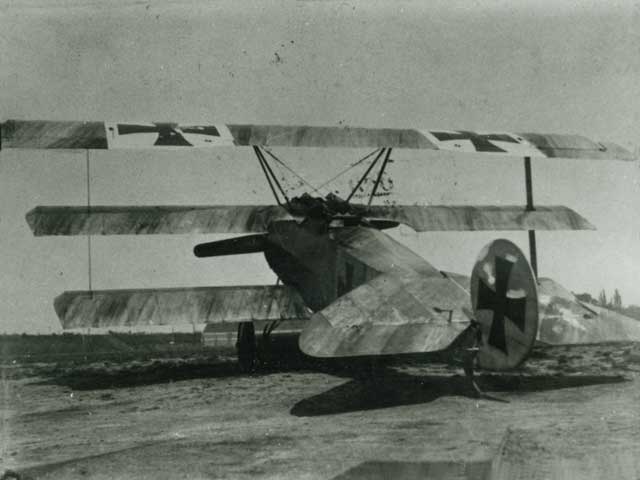
But one thing was for certain: None of the pilots present could hold a candle to his 48 confirmed aerial victories or to his natural uncanny ability as a pilot. Even the Rittmeister Baron Manfred von Richthofen himself, conceded at one time or another, that the only person who could possibly best him in aerial victories was Werner Voss. Manfred was Werner’s oldest and closest friend. They had first met in the autumn of 1916 at Jasta Boelcke and Werner was, for a time, the Red Baron’s wing man. They occasionally visited each others’ families when leave and time permitted. In fact many of the pictures taken at Krefeld, Germany on June 1917 were taken by Manfred von Richthofen. The time had come for them to mount their aircraft and head off to the front in search of prey. After Werner finished buttoning up his full length leather coat, donned his fur and sheepskin helmet and resting his goggles above his eyebrows, he mounted his Fokker F.I 103/17 with gloves in hand. He buckled his seatbelt, switching on the magneto and shouting “Contact” to his mechanic. The engine came to life with one turn of the propeller, and Werner adjusted the throttle pitch to his liking. He armed both of his machine-guns by pushing the charging handle forward and pulling the handles back, watching the ammo belt advance into the guns and waiting for the customary click signifying that his guns were armed and ready for action. In the same instant, his head swiveled back and forth as he checked his ailerons, rudder controls and the control column to ensure that they operated freely and were at his complete command. Crossing his hands with his palms outward in front of his face he indicated to his ground crew it was time to remove the chocks from his wheels. He then pulled his goggles down over his eyes, advanced the throttle a bit, and his aircraft advanced. His wingmen followed suit and tried to keep pace with their leader as they advanced down the field, until they glided into the air, leaving the earth behind. Werner looked down at the Marckebeeke airfield for perhaps the last time, as he soared into the heavens. Both of his wingmen Ltn.d.R Gustav S. Bellen on his right and Ltn.d.R Friedrich Rüdenberg on his left, were flying Pfalz D.III’s and were in their correct position behind him and slightly below as they climbed for altitude. Werner advanced the throttle of his Fokker triplane a bit and within moments crept ahead of the rest of his formation. He was far ahead and was extending the lead as they fell farther and farther behind and soon was almost out of sight. Leutnants Rüdenberg and Bellen, try as they might, were unable to catch up with the new Fokker F.I, due to their antiquated Pfalz D.III’s. Leutnant Rüdenberg witnessed Voss start his attack on a lone S.E.5 in the distance and since both of his wingman were so far behind, they were not able to cover his tail position. Fate then took over and history began. Here is a reconstruction of Voss’ last battle, as near as can be synthesized from the various and different sources: Around 5pm (British time) on the evening of 23 September 1917 Captain McCudden, along with Captain Bowman, took their respective flights into the air (a total of 13 SE5 aircraft composed the two flights) and flew towards the front lines. Capt. McCudden led “B” flight across the lines at Bixschoote.
That September evening a massive cloud formation at 10,000 feet effectively marked the operational ceiling and a thick cloud base covered his operational area. Capt. McCudden, and his flight, attacked an aircraft in his operational zone from 9,000 feet and after that engagement, the flight returned to 6,000 feet. At approximately 6pm that same day (German time), Ltn.d.R Friedrich Rudenberg and his wing man Ltn.d.R Gustav S. Bellen from Jasta 10 (flying Pfaltz D.IIIa) and their Commander, Ltn.d.R Werner Voss (flying his new superbly built Fokker F.I 103/17 triplane), took off from Marckebeeke airfield in Belgium. They headed toward the front lines in search of new victories. Ltn.d.R Voss soon out distanced his wingmen, due to the performance of his machine compared to theirs, both with whom had taken off with him earlier that evening. They had seen Ltn.d.R Voss attack a single-seat fighter, an S.E.5, in the distance, but they, unfortunately, were too far away to cover his tail. Captain McCudden flew north and over Poelcapelle, and saw in the distance that an SE5 (Capt. Hamersley, 60th Squadron) was spinning down with a hostile triplane (Werner Voss) on its tail. Capt Rothesay Stuart Wortley from No. 22 (Bristol Fighter) Squadron, observed Capt. McCudden and “B” Flight’s initial attack on Ltn.d.R Voss’s triplane from an additional 1,000 feet higher up than Capt. McCudden’s cruising altitude of 6,000 feet. Capt. Wortley noted that: ‘A red flare flickered from the leader of the SE5s. There was an enemy in sight, but search as he might he could see nothing. Then, all of a sudden he espied the Hun… a solitary, lonely Hun in a Fokker triplane.’ He became a spectator of what was to pass into history as an extraordinary aerial display of skill, courage and determination. Ltns. Rudenberg and Bellen saw Voss’ triplane being attacked from all sides with enemy machines. From their vantage point, Rudenberg could see that the enemy aircraft knew that they were not up against a beginner, but a man who knew his trade to the highest degree. For the rest of the aircraft in the vicinity of this extraordinary aerial display, hosted by Werner Voss and the members of 56 Squadron, it was a bullfight without benefit of a ring. Capt. McCudden and his flight of six went to the SE5’s rescue. Two other S.E.s of the eight were damaged from Archie (ground based anti-aircraft installations) and did not participate in the attack on Ltn. Voss, but both aircraft kept high cover for the attacking group. Both Capt. Hamersley and Chidlaw-Roberts of ‘C’ Flight were bringing up the rear of 60th Squadron, which was led by Capt. Cadwell of ‘B’ Flight, when Capt. Hamersley was attacked by Voss at approximately 1830 hours. Capt. Hamersley kept an eye on a large formation of between twenty and twenty-five Albartros scouts and had seen what he thought was a Nieuport being dived on by an Albatros. He swung across to attack the Albatros, and was surprised to see the “Nieuport” turn towards him. He suddenly realized it was a German triplane, not the Nieuport he initially thought. He put the nose of his SE down and opened fire. As he closed the range, he zoomed and turned but the triplane pilot had already anticipated his manoeuvre and was already above him, coming in from the side and firing accurate bursts into his S.E5. There was a puff of smoke from his engine and holes appeared along the cowling and the wings. Hamersley suddenly realized he was in a hopeless position and threw his aircraft into a spinning dive. Voss had anticipated his move again and followed him down, firing all the time, and Hamersley in desperation had to execute an inverted dive to escape Voss’s murderous fire. At that moment Capt. Chidlaw-Roberts saw his companion spin away and attempted to come to his rescue, turning to attack the triplane piloted by Werner Voss. Chidlaw-Roberts fired a few shots at Voss from close range, but the German pilot had once again anticipated his adversaries rescuing manoeuvre and hardly paused in his pursuit of Hamersley. Voss then executed a seemingly ‘impossible manoeuvre’. In seconds he was on the tail of Chidlaw-Roberts S.E.5 sending a stream of bullets ripping into his aircraft. The bullet damage done by Voss’s twin Spandau machine guns shot his rudder bar about so severely that he had to retire from the fray and that is all he saw of it. Capt. Cadwell saw McCudden of 56 Squadron “B” flight arriving. He then exited the scene and became more or less a spectator, than an active participant in the battle. As Voss followed his intended prey down, firing his twin machine guns as he went, he became suddenly aware of planes behind him. Maybe a sixth sense or experience or even pilots instinct, caused him to spin in his seat, just in time to see the flight of S.E. 5 fighters diving upon him from above. Voss and his triplane broke off their attack on Chidlaw-Roberts’ aircraft. He immediately turned and dropped into a perfectly executed half-spin and suddenly Voss found himself surrounded by enemy aircraft. He noticed, through situational awareness, that a flight of Camels were several thousand feet below, so flying in that direction was impossible and a flight of SPADs and Camels were circling high above, ruling out that direction as well. 56 Squadron started out organized and in pairs as they dove upon their prey. McCudden had formulated his trap, upon which he thought there was no escape for the German pilot. McCudden and 2/Lt. Rhys Davids were in the first pair and would attack Voss at roughly the same time. McCudden went right, Rhys Davids went left, 2/Lt. Muspratt and Capt. Hoidge both at the top and bottom of an open mouthed box with his remaining two SE5’s (Lt. Cronyn and Capt. Maybery) guarding any possible escape from the trawl. From McCudden’s perspective, his plan should keep the German from diving to escape the trap, as he would be surrounded by the Sopwith ‘Camels’ below. If he decided to climb above his trap, he would certainly be pounced upon, by the flight of SPADs and Camels from above. Voss on the other hand, had decided upon some evasive manoeuvres of his own concoction. Instead, he decided to fight it out. When the leading S.E.5 pilots depressed their respective triggers together and as the first resounding rattle from their .303 gunfire let loose, Voss did the incredible. He looked over his shoulder, saw them coming and turned ‘in a most disconcertingly quick manner, not a climbing or Immelmann turn’ Capt. McCudden wrote ’but a sort of flat half spin’. Lt. Cronyn wrote ‘Voss whipped around in an extra ordinary way, using no bank at all but just throwing his tail behind him’. Voss expertly utilized ‘the pitching & the acrobatic qualities’ of his rotary-engine triplane to his full advantage, against the faster but heavier and slower-turning S.E.5s. He accomplished this by kicking in full rudder, adding opposite aileron and adding a little elevator, so as to keep his aircraft level. All of this was completed in the blink of an eye. When Voss recovered from his unorthodox manoeuvre, he found himself surrounded by the six members of “B” flight and two of the S.E.5’s that he had initially attacked him from 60 Squadron. The odds were eight British aircraft against one German Fokker triplane. The growing number of Allied aircraft in the area, tended to seal Voss’s avenues of escape. As Voss turned his aircraft to face the approaching danger, he applied a bit more throttle power to his engine, and headed straight at his attackers. Voss was following the ‘Dictas of Boelcke’ after he had executed his flat, half-spin, which took the Allied flyers completely by surprise. What was even more surprising was that none of the bullets from either S.E.5 found their mark. He flew straight back towards his ambushers firing his twin Spandau machine guns as he came. What was once an organized, brilliantly conceived trap by McCudden for this lone enemy aircraft soon broke down into a classic barroom brawl, due to the tight turns and the superb flying skills of Voss. Another flick turn and Voss’ triplane was behind Hoidge and bullets tore into his aircraft. McCudden had taken the first burst of Voss’s machine-gun fire through his wings and had broken away sharply. When he had recovered from his initial shock McCudden wrote ‘The pilot seemed to be firing at all of us simultaneously’. Voss was now in the middle of the S.E.5 formation, all of whom dove at him in turn, but Voss seemed unperturbed by the odds and made no attempt to escape from the action. McCudden got behind Voss a second time, but could hardly stay there for a second.
Voss’s movements were so quick and uncertain that none of “B” flight could hold him in their sights for any decisive length of time. Voss came towards McCudden head on and slightly underneath, and had apparently not seen him. McCudden dropped the nose of his aircraft a bit; got Voss well in his sights, and pressed both triggers. As soon as he fired, up came the nose of Voss’ triplane and McCudden heard Clack-Clack-Clack-Clack, as Voss’s bullets passed close by him and through his wings. He distinctly noticed the red-yellow flashes from Voss’ parallel Spandau guns and as Voss flashed by, McCudden caught a quick glimpse of a black head inside the triplane, with no hat on at all.
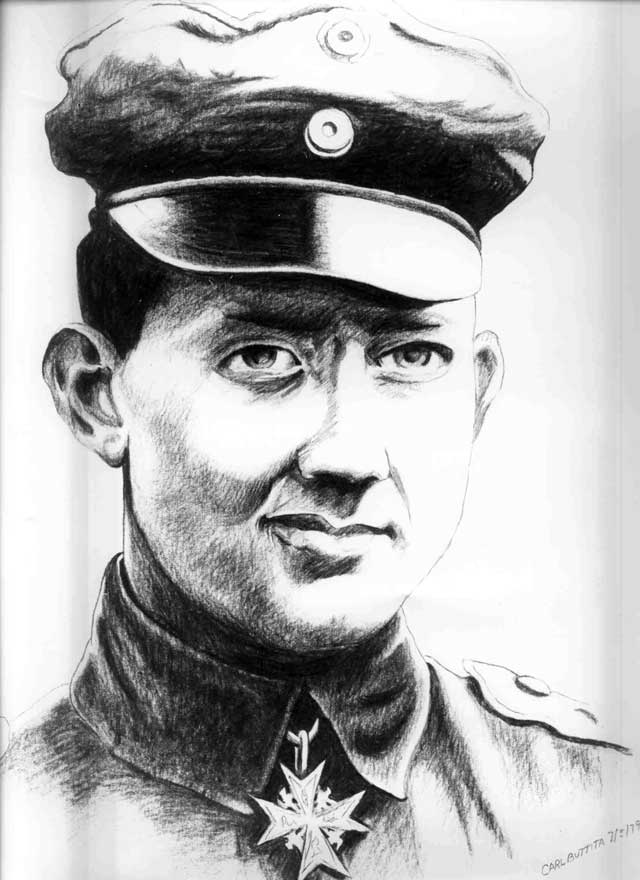
The triplane twisted, turned, climbed and dived, spreading the English fighters over many miles of sky and frustrated their attempt to shoot him down. At least three times the S.E.5 pilots tried to use their advantage of speed and numbers to build a net to snare the snarling twisting triplane, and all three times Voss escaped their trap. Lt. Cronyn, who was bringing up the rear, was the last to dive on Voss’ triplane. He put what he thought was an accurate burst of fire into the enemy aircraft, only to find out that he had lost considerable fuel pressure pulling out of the diving attack on Voss, and his zoom became a feeble climb. Voss, on seeing his feeble attempt, whipped round in an extraordinary way using no bank at all. He just threw his tail behind him and attacked Cronyn from the side and at that time Cronyn had the unique opportunity to observe that it was one of the latest designs of the enemy, a triplane. Voss was at very close quarters with him now and could hardly miss him. His bullets ripped all around Cronyn and as would be natural a month or so ago he would have dived for cover in the air below. But this time experience took over and he did not attempt to run. He merely dropped his aircraft’s nose just enough to give him some speed in which to turn under Voss’ triplane and prevent him from getting onto his tail. Cronyn repeatedly executed the same manoeuvre and at one point, when Voss was getting real close, Cronyn resorted in desperation to an old method for shaking off a pursuing machine. On the second revolution of the spin Cronyn flattened his aircraft out and to his relief; the triplane was no longer pursuing him. Voss was by now busily scrapping with the rest of ‘B’ flight and left Cronyn to his own devices. As the fight continued, a formation of Albatros D.V fighters arrived in the sky above, but was kept in check by a formation of SPADs and Sopwith Camels. A red-nosed Albatros D.V controlled by Ltn. Carl Menckhoff of Jasta 3 broke through the corridor of SPADs and came to Voss’s assistance. He joined his compatriot in the fight and Menckhoff tried to guard Voss’ tail as best he could. Alex Revell notes in ‘High in the Empty Blue: The History of 56 Squadron, RFC/RAF 1916-1920’ that ‘for a time, the Albatros and Voss cooperated well, covering each other and causing a great deal of problems for the S.E.5a’s’. Voss had by this time disposed of two of the four S.E.5s of ‘B’ flight which had initially attacked him. Cronyn was out of action due to bullets being sent through the sump and oil pipes of his aircraft and 2/Lt. Muspratt’s S.E.5 was forced out due to several bullets tearing into his radiator, causing his engine to seize. Both pilots dove away for the safety of the British lines. By all British accounts, McCudden was the finest Marksman in the Royal Flying Corps and few German Pilots escaped his machine-gun dance once they appeared in his gun sights. During this unusual September battle, McCudden managed to get behind Voss’ triplane on only two occasions. At the exact moment when he was just about to pounce and the triplane was directly in his sights, Voss would flip away from him with another of his intricate aerial manoeuvres, only to dart off to attack one of the other English fighters in the melee. Throughout McCudden’s military career as a pilot, he hardly ever permitted himself to get in a position whereby enemy bullets could pierce his plane. It was one of his guiding principles in the air and suddenly Voss had poked holes in it. At one time during this uneven battle, Voss’ twin synchronized Spandau’s machine guns, raked both wings of his S.E.5 aircraft. The sun was slowly setting against the horizon and Voss flew like a possessed man against the remaining 7 S.E.5 pilots facing him. He executed lightning fast turns and expert zooms, the likes of which no one up to that time had seen and quite possibly would never see again. His frustrated enemies were, for the most part, shooting at thin air or at a spot just recently vacated by his aircraft moments before. He on the other hand, executed spectacular slide slips and flat turns and at the same time continued to riddle their aircraft with exact and precise machine-gun fire to the point that he was damaging their aircraft far more than they were damaging his. By now, Capt. Bowman and three members of ‘C’ flight arrived on the scene without the two pilots of his formation that got lost in the descent and wandered off. Now it was Voss and the red-nosed Albatros against: McCudden, Rhys Davids, Bowman, Maybery and Hoidge. The reason for Hoidge’s delay was that he had just shot down a green scout who had been attacking Capt. Maybery. Bowman had initially led Maybery down into the Voss fight and while Maybery tangled with Voss, Hoidge continued to follow the green scout down. He changed his Lewis gun drum before climbing back into the action. When Hoidge returned to the fight, he attacked the triplane, which was flying directly at McCudden. Hoidge fired about 150 rounds from his Vickers and a ½ drum from his Lewis at Voss’s triplane with no apparent effect. As Maybery attacked Voss, the red-nosed Albatros got on his tail, forcing him to do a climbing turn to escape its machine gun fire. Maybery again dove on the triplane but his Lewis gun stopped and both German pilots turned toward him, only to be attacked in turn by McCudden and Rhys Davids. As Rhys Davids attacked Voss, the red-nosed Albatros took the opportunity to get on Rhys Davids tail. Maybery came quickly to his aid, firing his Vickers at the Albatros until he was forced to pull up over the top of it. Again Alex Revell notes comments made by Capt. McCudden that ‘there were times when Ltn. Voss was above all of the other S.E.s… yet he dove back into the fight rather than disengaging.’ At one point, Rhys Davids encountered Menckhoff’s red-nosed Albatros, attacked him and shot him down with one .303 round in the engine. Menckhoff was forced to crash land his aircraft north of Zonnebeke, Belgium.
By now, Voss was alone again in the fight, circling in the middle of the S.E.5s which all fired at him as the chance or opportunity arose. McCudden wrote ‘at one time Ltn. Voss’s triplane was in the apex of a cone of tracer bullets from at least five machines simultaneously and did not appear to do him any harm.’ Voss’ triplane was riddled full of holes and it was a measure of the pilots ability that he came out of it at all. Still he went back into the melee for another go. His aircraft was holed, but as long as he could mask that from the British he had an edge.

Maybery acknowledged as much when he simply wrote “he seemed invulnerable” as he struggled with his aircraft. Voss has put several well placed rounds into the upper right-hand longeron of his aircraft, forcing him to withdraw from the fight. Voss was again flying head on towards McCudden’s SE5a. Hoidge saw his chance and fired a long burst, putting a full drum from his Lewis gun into the triplane on Voss’s starboard flank. He had attacked Voss in this same manner four or five times throughout the battle, but he had not seen what effect this had on Voss’ aircraft. These attacks seemed to have little or no effect on Voss’s flying ability and he did not see anything after this attack either. Bowman and the fight had now descended to approximately 2,000 feet and roughly a mile behind the German front lines. This left Voss alone in the middle of the six S.E.5 aircraft. Bowman recalled ‘that it did not appear to deter Voss in the slightest. At that altitude Voss’s triplane had a much better rate of climb, or zoom than the S.E.5s had and frequently Voss was the highest machine of the seven attackers and could have easily turned East and gotten away had he wished to, but Voss was not that type and always came down into the fight again and again.’ Capt. Bowman again recalled ‘that Voss’s machine was exceptionally manoeuvreable and he appeared to be able to take flying liberties with impunity.’ Bowman stated in his writings ‘that he had his one and only crack at Voss and this was when Voss was about to pass broadside across his bows and slightly lower. Bowman put the nose of his S.E.5 down and gave Voss a burst of machine gun fire, perhaps a little too soon; to Bowman’s amazement Voss kicked on full rudder, without banking, pulled his nose up slightly and gave him a burst in return; all the while he was skidding sideways. Voss then kicked on opposite rudder before the effects of his amazing stunt appeared to have any recognizable effect on the controllability of his machine’. Bowman’s aircraft began to trail steam and black smoke as he limped along after Voss’ latest attack. He was effectively out of the fight, but he might have given Lt. Rhys Davids a slight advantage in this contest of skills. Rhys Davids had temporarily flown off to the side of the fight to change the drum on his Lewis gun. He now returned to the action. Minutes later at about 2,000 feet, the S.E.5 aircraft piloted by Rhys Davids gained some altitude and managed to catch the German ace in a straight flat dive. He approached Voss cautiously from behind and slightly above. At last, Rhys Davids was on Voss’s tail at about 1,500 feet. This was possible, perhaps, due to Voss’ latest flat turn that he executed to evade Bowman, and enabled Rhys Davids to get into that position. It is unknown if Voss’s attention was momentarily distracted by his latest escape manoeuvre. But whatever the reason, Rhys Davids was there, with his prop boss almost glued on the triplane’s rudder. For a few seconds the Fokker filled Rhys Davids ring sight and he fired a long burst from both his Lewis and Vickers machine guns. His bullets raked the triplane from end to end. Suddenly, the Fokker triplane stopped its defensive gyrations and began to glide toward the west in a slow and gentle manner. Rhys Davids noted: ‘The aircraft made a slow right hand turn, wing down, I couldn’t see the pilots head, as it seemed to be low in the cockpit’. After this, Rhys Davids observed Voss’ triplane flying nose down and straight for the first time and making no attempt to turn. Rhys Davids remained on his tail then turned away. Voss then made his final fatal error: he also turned, directly into the path of Rhys Davids S.E.5 and slightly below. Rhys Davids probably could not believe his eyes or luck and wasted no time in pitching the nose of his aircraft down slightly. He fired a whole drum of Lewis rounds and a corresponding number from his Vickers into the triplane. Once again Voss made no attempt to turn until Rhys Davids was so close to him that it was certain that both aircraft would collide and Rhys Davids veered off. Voss was possibly already dying in the cockpit at this time and his aircraft was slowing down and flying level. Ever so slowly it went down, gently gliding westward. Voss passed Rhys Davids right wing by inches and started its final decent down. Rhys Davids zoomed and noticed that Voss’ engine was apparently off to prevent a fire when he crash landed. Rhys Davids dove again and got one more shot out of his Vickers. He reloaded his Lewis gun while in his dive and got another good burst into the triplane, which did a slight right-hand turn, still going down. Suddenly its glide steepened. Rhys Davids closed in on the triplane and overshot him at 1,000 feet. He zoomed away and never saw Voss again. Voss’ triplane apparently stalled near the ground, flipped over on its back and crashed in a flat, nose slightly down position. It literally seemed to go to powder as it crashed into the muddy fields below. The only apparent visible wreckage of the aircraft that survived intact was the tail rudder pointing somewhat skyward. Both McCudden and Bowman witnessed the end of the triplane. McCudden had climbed above the fight to change a Lewis gun drum and looking down observed Voss’s final moments. McCudden wrote ‘Voss was very low, still being engaged by an S.E. marked “I” (2/Lt. Rhys Davids). The triplanes movements were very erratic, and then McCudden saw Voss go into a fairly steep dive and while watching, saw the triplane hit the ground and disappear into a thousand fragments, for it seemed to McCudden that the triplane literally went to powder’. Bowman later recalled of the incident ‘When near the ground the triplane turned over on its back seconds before the aircraft ploughed into the ground in an inverted position. At no time was the angle of descent steeper than an ordinary glide-in to land.’ That evening, worries beset the Geschwader when Ltn. Voss failed to return. Ltn. Rudenberg (from Jasta 10) noted, ‘…that as night progressed and we had not heard anything as to the fate of our Jagdstaffel leader, worry set in. At night we finally received news from out first (front) line about an aerial fight between one German and six Englishman – the German crashed. The next morning we all flew over the Front and dropped a letter with a long ‘Black-White-Red’ Banner requesting notification about the fate of Ltn. Voss.’ British soldiers found the remains of the triplane and the body of the pilot and salvaged what they could, that same day or very early the next morning. Ltn.d.R. Voss had come down just north of St. Julian, some half a mile behind the British front lines. The crash site was close by an entrenched position known to the British as Plum Farm. The pilot’s body was buried in a nearby shell hole the morning of 24 September 1917, without coffin and without ceremony. This was a common practice to all airmen or soldiers alike, which fell within this war torn land. That same morning, No. 56 Squadron got the telegram from RFC headquarters. The dead pilot had been found wearing the Boelke collar and at his neck he wore the Pour Le Merite. His name was Werner Voss. In addition, General Trenchard from RFC Headquarter sent an aide to 56 Squadron to elicit details of the battle. (This aide happened to be Lt. Maurice Baring – Intelligence Corps.) In this report Capt. James McCudden paid the following tribute to Ltn. Voss: ‘As long as I live I shall never forget that German pilot who single-handedly fought seven of us for ten minutes, and who put some bullets through all our machines. His flying was wonderful, his courage magnificent, and in my opinion is the bravest German airman whom it has been my privilege to see fight’. 2/Lt. Rhys Davids, who had put the last machine gun burst into Voss and was given the credit for his demise, later said to Capt. McCudden ‘If I could only have brought him down alive’; a wish shared by Capt. McCudden as well. Arthur Rhys Davids also noted in a letter addressed to his Mother, Father and Sister on 28 Sept 1917, “I take my hat off to Voss; he was the bravest fellow and the best scrapper I have ever met.” Capt. Baron Manfred Von Richthofen was on leave and still hunting, as a guest of the Duke of Saxe-Coburg-Gotha in Thuringia on the 24th of September 1917, when he received a telegram from HQ, that his friend Ltn.d.R. Werner Voss was posted as missing in Action and presumed down in enemy territory. The wreckage was found, upside down, this side of the British lines. 2/Lt. Barfoot-Saunt observed on 27 October 1917, that the upper and middle wings, could not be salvaged as they were just too badly damaged in his intelligence report. His report also mentions that the wreckage had remained out in the open, exposed to the elements and shellfire for more than a month before a detailed inspection of the craft could be carried out. Too add a simple twist to this incredible story. On that very day that Ltn Barfoot-Saunt was beginning his investigation of Ltn. Voss’ crash site, 2nd Leutnant Rhys Davids the man who was credited with Voss’ downfall. Was himself killed in action by Leutnant Karl Gallwitz, of Jasta 2. Lt. Rhys-davids was buried where he fell, and like Voss, his grave was lost to history. Both men’s unknown graves are less than 5 miles from one another. So was Ltn. der Reserve Werner Voss a Hero or Super Hero? I believe he was both.
Thomas Crean
Photos: Reinhard Kastne and Terry Phillips; Color Profile: Srecko Bradic; Graphic Art: Carl Buttita.
Sources:
A Pictorial History of Luftwaffe 1910-1960 / Vol II – 1916 – 1917 H. J. Nowarra Brief Glory – the Life of Arthur Rhys Davids DSO MC and Bar Alex Revell Brief History of No. 56 Squadron R.A.F H. H. Russell Vol.1-1960-Issue 4 Captain RA Maybery H.H. Russell Vol.14-1973-Issue 2 Childlaw-Roberts, Robert Leslie MC RAF David Tappin Vol 20-1989-Issue 2 Colors – Gustav S. Bellen Greg Van Wyngarden Vol.2/No4-Winter-1987 Der Silberne Dreidecker Heinz J. Nowarra Eagles of the Black Cross Walter Musciano Fighter Pilots of WW I Robert Jackson Fighting Planes and Aces W.E. Johns Fighting Triplanes, The Evan Hadingham First Great Air War – WW1: Life and Death In The Air 1914-1918. HB.1ST. Richard Townshend Bickers Flieger Des Weltkrieges Roeingh, Rolf Flying Aces of World War 1 Gene Gurney Flying Corps Headquarters, 1914-1918 Maurice Baring Flying Fury: Five Years in the Royal Flying Corps James McCudden James McCudden Flying Hussar, The Douglass Whetton Fokker Dr 1 Aces of WW 1 Norman Franks & Greg Van Wyngarden Fokker Triplane, The Peter M. Bowers Vol.5-1964-Issue 1 Fokker Dr.I Triplane: A World War One Legend Paul Leaman / Harry Dempsey German Air Aces of World War 1 Alex Imrie German Aircraft Down in British Lines: RFC/RAF ‘G’ Numbers F. Hitchins Vol.10-1969-Issue 2 German Knights of the Air 1914 – 1918/ The Holders of the Order Pour Le Merite Terry C. Treadwell & Alan C. Wood Geschichte Des Fokker Dreideckers F-T-S Achim Sven Engels Give Me Yesterday, Capt R.I. Chidlaw-Roberts Douglass Whetton Vol.20-1979-Issue 4 ‘Grid’ Cadwell of No 74 Sqn. RAF R. H. Russell Vol.10-1969-Issue 3 Heroes & Aeroplanes of the Great War, 1914-1918 Joseph A. Phelan High in the Empty Blue: The History of 56 Squadron, Rfc/Raf 1916-1920 Alex Revell Hunting With Richthofen: The Bodenschatz Diaries: Sixteen Months of Battle With J.G. Freiherr Von Richthofen No 1. Jan Hayzlett Intelegence Report C & C Intern- Vol. 6, No.3’ Into the Blue Norman MacMillan James McCudden VC Alex Revell Jasta Boelcke T. G. Miller, Jr. / W. R. Puglisi Vol.9-1968-Issue 4 Letters from a flying officer Rothesay Stuart Wortley Letters from German Jagdstaffel Personnel of World War 1 W. R. Puglisi Vol.1-1960-Issue 1 Leutnant de Reserve Fredrich Rudenberg Dov Gavish, PhD and Dieter H.M. Groschel, M.D. Vol16/No2-Sum-2001 LT. Werner Voss – Germany’s Greatest Teenage Ace Walter A. Musciano Manfred Von Richthofen: The Man and the Aircraft He Flew David Baker Mammoth Book of Eyewitness WW I, The Jon E. Lewis Mammoth Book of Fighter Pilots, The Jon E. Lewis Planes the Aces Flew Vol. 1, The Len Morgan & R.P. Shannon / Arco Pub. Co. Red Baron Combat Wing, The: Jagdgeschwader Richthofen in Battle Peter Kilduff Red Baron’s Lone Wolf Rival, The O’Brien Browne (Aviation History) Reginald T.C. Hoidge MC, Capt. H.H Russell Vol.7-1966-Issue 4 Reminiscences of Jasta 10 Heinz H. Nowarra Vol.3-1962-Issue 3 Rhys-Davids of 56 Sqn. RFC H.D. Hasting and Lonnie Raidor Vol. 8-1967-Issue 4 Richthofen A. E. Ferko ‘Richthofen’s Circus’:Jagdgeschwader Nr 1 Greg Vanwyngarden and Harry Dempsey Royal Flying Corps Communiqués: 1917-1918 Chaz Bowyer September Evening–The Life & Final Combat of German WW 1 Ace- Werner Voss Barry Diggens Triplane Fighter Craze of 1917, The Robert Guttman HistoryNet.com Under the Guns of the German Aces Norman Franks & Hal Giblin Von Richthofen and the Flying Circus D.A. Russell / HarleyFord Pub Western Front Assoication Westernfrontassociation.com Werner Voss – Aftermath Alex Revell Vol.6-1975-Issue 3 Werner Voss’s Fokker Dr1 F.I 103/17 H.H Russell Vol.1-1960-Issue 4 Werner Voss, The Last Hussar Dennis Hylands Who Downed The Aces of WW 1 Norman Franks Worcestershire Regiment Worcestershireregiment.com The Aerodrome theaerodrome.com Proof-Reader’s James M. Livingston/Leslie J. Crean Quote Permissions Alex Revell
Every year come September 23, I remember Werner Voss. May he rest in peace. Thanks for this great web page!
Great! This is a fantastic piece of history about Werner Voss. I love it. You can read more about Voss on my website http://www.redbaronshop.co.uk where there is a ‘make it yourself’ board game for kids and adults. PC games are okay, but this board game is really good fun to make and play.
any relation to?
Does anyone the correct color of Voss,s uniform and cap,capband and piping?
Does anyone know the correct color of Voss,s uniform,cap,capband and piping on uninform and cap?
This Werner Voss looks a lot like my grandfather and great grandfather Robert Voss and Edwin J Voss. Any info on a family tree?
I knew how Warner Voss had died. But your prose was very exciting to read. Thank You.
RIP all those brave men from WW1.