
Dutch flying boats and amphibians
Fokker designs:
Fokker W.1
The first flying boat designed under the leadership of Anthony Fokker was the W.1. It was built in Germany in 1913 before the outbreak of the First World War as a Schneider Cup contender. It only made a few hops and crashed already during the first flight tests.
The W.1 was powered by a 70 hp Renault engine.
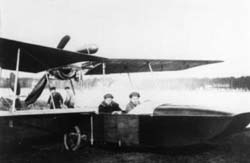
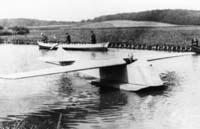
Fokker V.42
Originally, this type was designed as V.40 during the First World War as an unmanned flying bomb, to be towed by a Fokker D.VII fighter. After the war, Fokker developed in further into the V.42. It was built at the Veere workshop in the province of Zeeland as a small glider in flying boat form, although it was before flight-testing also fitted with wheels. It was a few times tow-launched by a power boat during unmanned experiments carrying only ballast and one single time flown by pilot Adolph Page before all experiments were terminated in 1921.
Fokker B.1
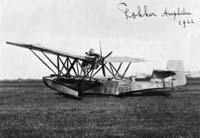 Designed by H. Rethel shortly after the end of the First World War as a four-seat patrol flying boat for use by the Dutch navy MLD in the Dutch East Indies, the Fokker B.1 made its first flight in September 1922. Anthony Fokker himself was the pilot on this occasion. Just like the V.42, the B.1 was also built at the Fokker workshop at Veere. The B.1 was of mixed construction. The hull was completely made of light-alloy while the biplane wing and tail surfaced were made of wood and fabric. For use on land, it could be fitted with a wheel undercarriage. After completion of the test flights, the B.1 was shipped to the East Indies for operational testing. The conclusion was that because of the constantly leaking fuselage, the B.1 was unsuitable and no more machines wereordered. The single B.1 was eventually scrapped with the arrival of the first Dornier Wal flying boats.
Power plant: Napier Lion liquid-cooled in-line engine of 450 hp, driving a four-bladed pusher propeller
Wing span: 18.12 m
Length: 11.86 m
All-up weight: 2600 kg
Max. speed: 185 km/h at sea level
Fokker B.2
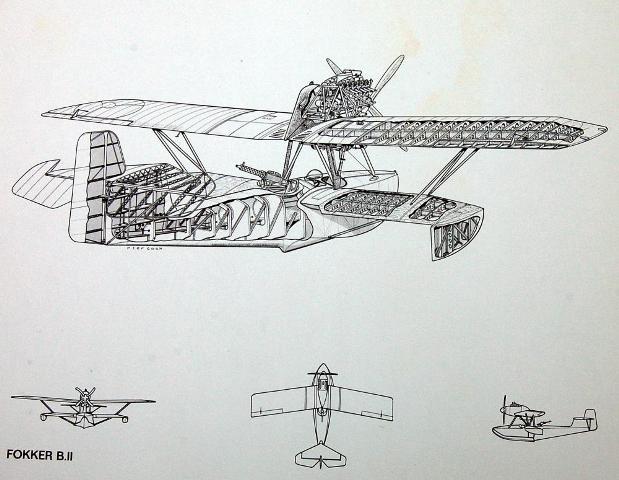
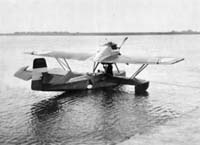 The next Fokker design was developed in 1923 as the B.2. Just like the B.1 it had a light-alloy hull and biplane wooden wings with fabric covered control surfaces. The B.2 was intended as a three-seat sea-reconnaissance plane with the possibility to be hoisted on board of warships and to be launched by a catapult. Just like the B.1 it could be fitted with a wheel undercarriage for land operations. The first flight was made on 15 December 1923 from the water of Schellingwoude near Amsterdam. The B.2 was also tested by the Dutch navy for operational use, but just like the B.1 it was found to be unsuitable. Although the B.2 carried Dutch military markings, the single prototype built was never purchased by the Dutch navy! Fokker tried unsuccessfully to sell the B.2, but after a short time it was scrapped.
Power plant: Rolls Royce Eagle VIII liquid-cooled in-line engine of 360 hp, driving a four- bladed tractor propeller
Wing span: 13.50 m
Length: 9.91 m
All-up weight: 2400 kg
Max. speed: 190 km/h at sea level
Fokker B.3
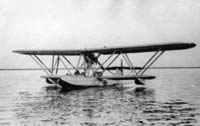 The B.3 from Fokker was a long-range reconnaissance patrol flying boat making its first flight on 10 November 1926. Other than the earlier B.1 and B.2 amphibians, the B.3 had no provision for a wheel undercarriage, making it a pure flying boat. It had a light-alloy hull and a top wing of mixed fabric-plywood construction. The lower wing was plywood throughout. The B.3 was a 3-seater. It had a seat for an observer in the nose and two separate open cockpits with dual control for two pilots. The B.3 was offered to the Dutch navy MLD for use in the Dutch East Indies, but just like its predecessors it was not accepted. Fokker converted the B.3 later into a luxury cabin plane for six passengers and finally sold it to the American millionaire Harold Vanderbilt. This conversion took most likely place in the Netherlands, although it also possible it was done at the US Fokker plant at Hasbrouck Heights near Teterboro New Jersey. Carrying the civil registration NC149 (later changed into NC3996) it was used for pleasure flights around Long Island. The B.3 was destroyed during a hangar fire in March 1928.
Power plant: Napier Lion liquid-cooled in-line engine of 450 hp, driving a four-bladed pusher propeller
Wing span: 18.00 m
Length: 11.90 m
All-up weight: 3090 kg
Max. speed: 180 km/h at sea level
Fokker B.4 (F-11)
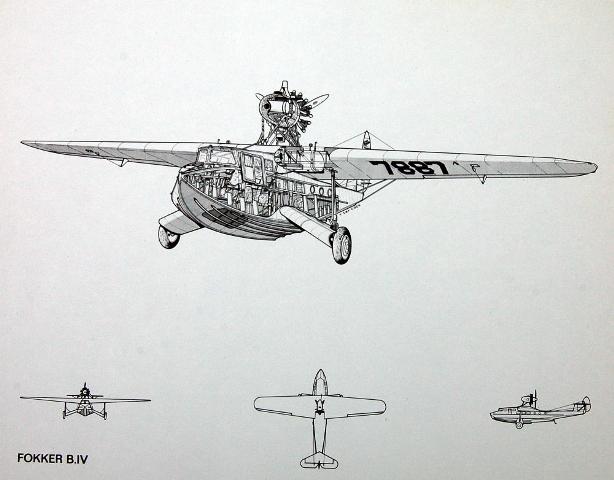
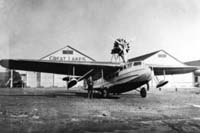 After the crash of the single B.3, Harold Vanderbilt was interested in a new flying boat. Fokker had meanwhile founded an aircraft factory in the US at Hasbrouck Heights near Teterboro, New Jersey. Here, Fokker tried to combine the B.3 design with the wooden wing of the U.S. built Fokker Super-Universal and, just like the B.1 and the B.2, with a fixed wheel undercarriage. Finally a more or less complete new design was built under the designation B.4. The U.S.-Fokker type designation given was Model 11. Since the Hasbrouck Heights plant had at that time no experience with light-alloy construction, the hull of the B.4 was manufactured at the Fokker works in the Netherlands and shipped to the U.S. The first flight with the new B.4 with construction number 902 was made in 1928. At that time, no wheels were fitted. It had a crew of two and capacity for six passengers. The engine was mounted in a pylon on top of the single wing. Originally, the B.4 was fitted with a 400 hp Pratt and Whitney Wasp radial engine driving a tree-bladed tractor propeller, but later this was replaced by a 500 hp Wright Cyclone. Carrying the civil registration 7887 (later NC7887), it was purchased by Harold Vanderbilt in September 1929 and used for pleasure flying around Long Island. The first B.4 was finally destroyed in September 1938 in a hurricane.
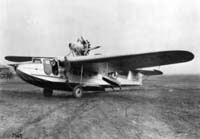 At the Hasbrouck Heights plant, Fokker set up a small production line of an improved version of the B.4, known as the B.4A or Model 11A. An additional number of hulls were manufactured at the Amsterdam plant and at least six of them were shipped to the United States. However, with the U.S. in the middle of the big economic depression Fokker failed to gain substantial orders and finally only five were completed with construction nos. 902 up to/including 906. A number of hulls were never mated with their wings and at least two remained in the Netherlands for some time. One was shown in 1937 during an aviation exhibition in The Hague and another one ended up in the collection of the Technical University at Delft where it was scrapped in the sixties!
The five additional B.4A’s were:
c/n 902: remained in the custody of Fokker/General Aviation with civil registration 148H; later changed into NC148H. This type was later converted to a twin- engined version with tractor and pusher engine in the same engine nacelle on top of the wing. Scrapped at the end of 1931.
c/n 903: registration was 151H. Most likely never flown and also most likely never completed. It is possible the wings were used for repair of c/n 901 after a taxi incident in September 1929.
c/n 904 : civil registration 127M, later NC127M. Sold to Garfield Wood in 1930. Final fate unknown, but most likely scrapped before the outbreak of the war.
c/n 905: civil registration 843W. Tested in 1930 at Wright Field as C-16 but not accepted. Remained at Fokker/General Aviation. Construction number is not certain; could also be 907 or 908.
c/n 906: Last one completed in 1930. Carried civil registration 339H; later to be changed in NC339N. Sold to Air Ferries, San Francisco. Ended up finally in Canada as CF-AUV and crashed there on 28 June 1935. Greatest part of the hull recovered in 1978-1879. Hull was displayed at the former Aviodome museum at Schiphol airport. After closure of this museum, it went into storage at the new Aviodrome museum at Lelystad airport for future display.
Power plant: Wright R-1750 Cyclone radial engine of 500/525 hp. 450 hp, driving a three- bladed pusher propeller. c/n 902 and c/n 906 were fitted with a Pratt and Whitney Hornet B of 575 hp
Wing span: 17.98 m
Length: 13.72 m
All-up weight: 3105 kg
Max. speed: 179 km/h at sea level
Koolhoven designs:
Koolhoven, the ‘second aircraft manufacturer next to Fokker in the Netherlands’ never actually constructed a flying boat, although they designed a 3-engined ocean patrol flying boat in the thirties. Also Fokker designed a similar ocean patrol flying boat but this was just like the Koolhoven design never built. The Dutch navy selected eventually for use in the Dutch East Indies the design proposed by the German Dornier works. It became later well known as the Dornier Do-24. Also a Koolhoven design for a multi engine big transatlantic passenger flying boat of all-metal construction in the same class as the later Boeing, Martin and Sikorsky ‘ Clippers’ never progressed any further than the drawing board!
De Schelde:
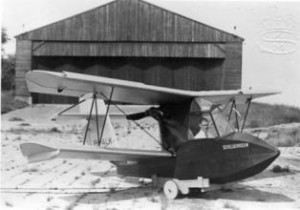 The only other flying boat/amphibian actuallybuiltand flown in the Netherlands was a small ultra-light built by De Schelde and powered by a light Czech engine. It was based on an earlier ultra-light fitted with wheels, the Scheldemusch (musch = sparrow). The flying boat was appropriately named the Scheldemeeuw (meeuw = seagull). Both Scheldemusch and Scheldemeeuw were designed by Theo Slot. The Scheldemeeuw made its first flight on 19 June 1936, carrying the civil registration PH-ALK. It was built as a biplane with a wooden hull and wooden wings and tail surfaces covered with fabric. The engine was mounted behind the cabin driving a two-bladed propeller. During test flights the small flying boat was found to have good flight characteristics. Also on the water, it handled very well and it took only a 60 m run to get airborne. In spite of the attractive design and looks (it was painted in a bright red/silver dope colour scheme), De Schelde failed to gain any orders and no more were built. To gain experience with the all-metal hull construction of the Dornier Do-24 that De Schelde later built for the Dutch navy, the original wooden hull of the Scheldemusch was later replaced by a light-alloy hull of grossly the same layout. In this form it was flown in 1938 with a new registration; PH-ATM. The little flying boat was finally scrapped in 1940.
Power plant: Praga B engine of 40 hp
Wing span: 6.78 m
Length: 5.32 m
All-up weight: 300 kg
Max. speed: 125 km/h at sea level
Literature:
-Theo Wesselink and Thijs Postma, De Nederlandse vliegtuigen, Unieboek-Bussum, the Netherlands 1982
-Hugo Hooftman, Scheldemusch en Scheldemeeuw, Nederlandse Vliegtuigencyclopedie no. 7, Cockpit Uitgeverij-Bennekom, the Netherlands 1978
-Thijs Postma, Fokker- Bouwer aan de wereldluchtvaart, Fokker-VFW- Schiphol, the Netherlands 1979
-Hugo Hooftman, Van Farman tot Neptune, Part 1, La Rivière & Voorhoeve, Zwolle, the Netherlands 1964
-Theo Wesseling and This Postma, Koolhoven-Nederlands vliegtuigbouwer in de schaduw van Fokker, Unieboek-Bussum, the Netherlands 1981
-Henri Hegener, Fokker – The man and the aircraft, Harleyford Publications, UK 1961
-Anonymous, Fokker: casette with 50 technical drawings of Fokker types, Fokker Aircraft,-Schiphol-Oost, 1971
Nico Braas
All images from authors collection
As I am building Golden Age aircraft and actually do the Fokker F.11, I’d like to find good quality drawings of Pictures of civil aircraft and especially F.11 / B.IV: Can you help?
Hi. Same question: What are the chances of obtaining a higher resolution jpg of the Fokker F.11/B4 cutaway & 3-view?
Hello Sirs!
I am attempting to locate a photo to accompany an article I expect to write on the Fokker F-XI-AHB.
Your site has some — are they available?
Standing by
Robert S. Grant