Show Posts

This section allows you to view all posts made by this member. Note that you can only see posts made in areas you currently have access to.


Messages - mfg495

Pages: 1 ... 22 23 [24] 25 26 ... 110
346
Warplane Art / Re: Hawker Typhoon
« on: June 05, 2010, 02:10:35 PM »
A bit more info:

"The Typhoon FR IB was developed in early 1944 and was used as a tactical reconnaissance fighter. In this version the port inner cannon was removed and three F.24 (one forward facing 14 inch and two vertical five inch) cameras were carried in its place. Later, when it was found that the recoil of the two cannon on the starboard wing was not properly balanced by the single cannon to port, causing a yaw during firing, the starboard inner cannon was also removed from some aircraft. Because of the inherent airframe vibration the photographs produced were usually sub-standard. After some service with 268 Squadron from July 1944, the FR IB was phased out in January 1945."

So I was wrong about just the one camera. Please see attached images, not too clear, I will try and clean them up. This is another aircraft I will have to add to my site.

347
Warplane Art / Re: Hawker Typhoon
« on: June 05, 2010, 01:50:50 PM »
They were used in the Tac Recce role with the 2nd Tac Air Force, I will have to have a look at by books, but I think they were fitted with only a oblique F.24 camera.
I will have a look through my 2TAF books and confirm this

348
Warplane Art / Re: CH-47
« on: June 03, 2010, 08:38:09 AM »
No problem No.1

349
Warplane Art / Re: PRU Spitfires
« on: June 03, 2010, 08:37:15 AM »
These Spitfires were designed for high-level attack. A number operated in the Middle East for the same task, shooting down Luftwaffe reconnaissance aircraft

350
Warplane Art / Re: Hawker Typhoon
« on: May 29, 2010, 08:38:23 AM »
Great profile,

The first Typhoon to be flown by the Luftwaffe was EJ956 SA-I  of 486(NZ) Sqn. On 23 March 1943, two aircraft flown by F/O Smith and F/S Mawson were on a "Rhubarb" over France. Just as they were crossing the coast at low altitude, Mawson's Typhoon was hit by light flak. He managed to belly-land in a field near Cany-Barville, but the aircraft was captured before he could destroy it. The Typhoon was repaired and later served as T9+GK with "Zirkus Rosarius".

351
He 117  :-think

352
Warplane Art / Re: Last blog update
« on: May 29, 2010, 08:28:34 AM »
I would call you over worked No.1 not lazy....... :))

353
Warplane Art / Re: CH-47
« on: May 29, 2010, 08:27:02 AM »
No.1, if you wish I can post some images of RAF CH-47 in use  :-think

354
Combat Warplanes / Re: 204th aviation base Batajnica open day
« on: May 29, 2010, 08:23:47 AM »
Excellent set of images  :-ok

355
Combat Warplanes / Re: Payen
« on: May 26, 2010, 01:51:18 PM »
Excellent  :-obey :-obey

356
Warplane Art / Re: Nakajima Ki-43 Hayabusa
« on: May 02, 2010, 10:19:53 AM »
As always, a great profile  :-ok

357
Aircraft Modeling / Re: 1/32 scale Puma
« on: April 24, 2010, 09:41:48 AM »
I will pass on your comments and see if he has any of images of this work  :-think

358
Combat Warplanes / Re: Spitfire on Floats
« on: April 24, 2010, 09:40:25 AM »
Until this topic I thought that there was only two float Spitfires!
As I my friend

359
Combat Warplanes / Re: Spitfire on Floats
« on: April 23, 2010, 10:38:37 AM »
Spitfire Floatplanes (types 355 & 359)

With the German invasion of Norway in April 1940 the RAF took an interest in the concept of using floatplane fighters in areas where airfields were not immediately available. To this end a Spitfire Mk I R6722 was taken in hand at the Woolston factory to be modified and mounted on Blackburn Roc floats. Tank tests were carried out at Farnborough, using a 1/7th scale model, it was found that the concept was basically sound, although the vertical tail surfaces would need to be enlarged to counter-balance the side area of the floats. The end of the Battle of Norway and the need for as many Spitfires as possible meant that R6772 was converted back to an ordinary fighter without being flown

With the entry of Japan into the war the concept was revived in early 1942. A Spitfire V W3760 was fitted with a pair of floats 25 ft 7 in (7.8 m) long, mounted on cantilever legs. This aircraft was powered by a Merlin 45 driving a four bladed propeller of 11 ft 3 in (3.43 m) diameter (3.4 m). A Vokes filter was fitted to the carburettor air intake and under the tail an extra fin extension was added. Other changes included external lifting points forward of and behind the cockpit and a spin-recovery parachute with a rudder balance-horn guard.

The Spitfire floatplane was first flown on 12 October 1942 by Jeffrey Quill. Soon afterwards the Vokes filter was replaced by an Aero-Vee filter, similar to that on later Merlin 61 series aircraft, which was extended to prevent water entry, and full Mk VB armament was installed. Two more VBs EP751 and EP754 were converted by Folland and all three floatplanes were transported to Egypt, arriving in October 1943. At the time it was thought that the floatplanes could operate from concealed bases in the Dodecanese Islands, disrupting supply lines to German outposts in the area which relied on resupply by transport aircraft. This scheme came to naught when a large number of German troops, backed by the Luftwaffe, took over the British held islands of Kos and Leros. No other role could be found for the floatplane Spitfires, which languished in Egypt, operating from the Great Bitter Lake.

Specifications for the VB based floatplane included a maximum speed of 324 mph (521 km/h) at 19,500 ft (521 km/h at 5,943 m), a maximum rate of climb of 2,450 ft/min at 15,500 ft (12.45 m/s at 4,724 m) and an estimated service ceiling of 33,400 ft (10,180 m)

In the spring of 1944, with the prospect of use in the Pacific Theatre, a Spitfire IX MJ892 was converted to a floatplane. This used the same components as the earlier Mk VB conversions. Jeffrey Quill wrote:

    "The Spitfire IX on floats was faster than the standard Hurricane. Its handling on the water was extremely good and its only unusual feature was a tendency to "tramp" from side to side on the floats, or to "waddle" a bit when at high speed in the plane."

Soon after testing started the idea of using floatplane fighters was dropped and MJ982 was converted back to a landplane.

Five aircraft were converted:

    * Mk I - R6722
    * F.Mk Vb - W3760
    * Mk V - EP751 and EP754
    * Mk IXb - MJ892

Source - internet  :))

360
Aircraft Modeling / 1/32 scale Puma
« on: April 23, 2010, 10:23:02 AM »
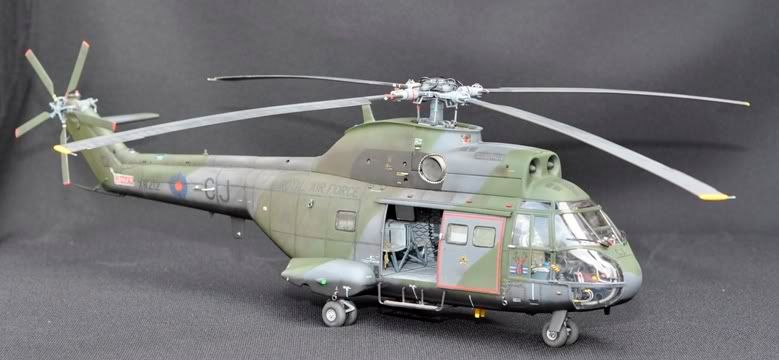
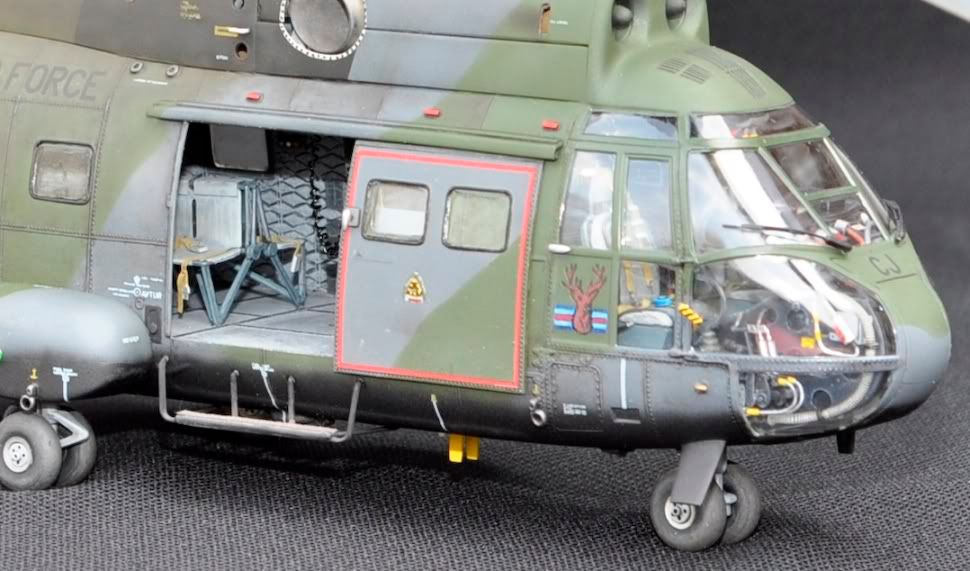
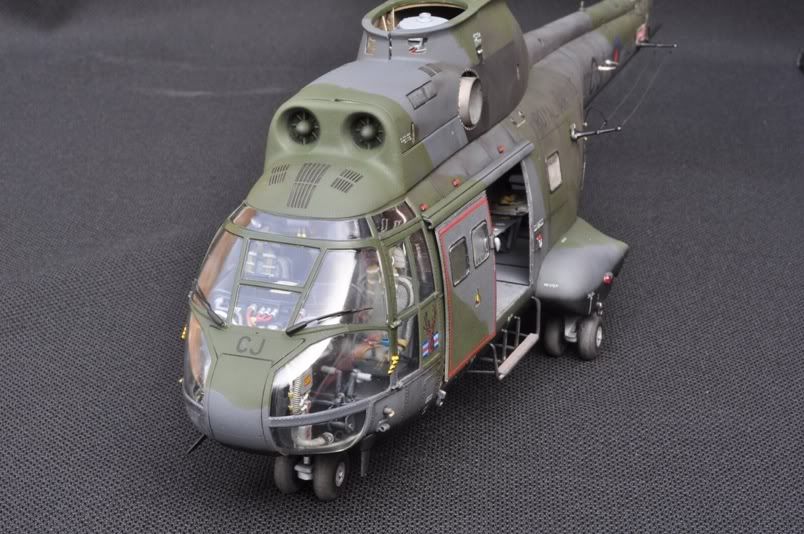
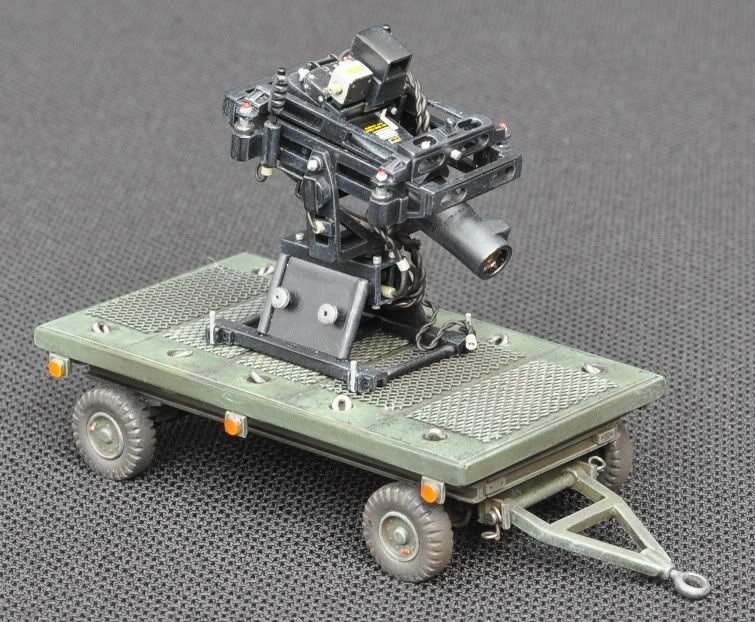
I thought you all may wish to see this stunning model of a 1/32 scale Puma. It was made by a friend of mind who did it for a leaving gift for an ex-Puma pilot.
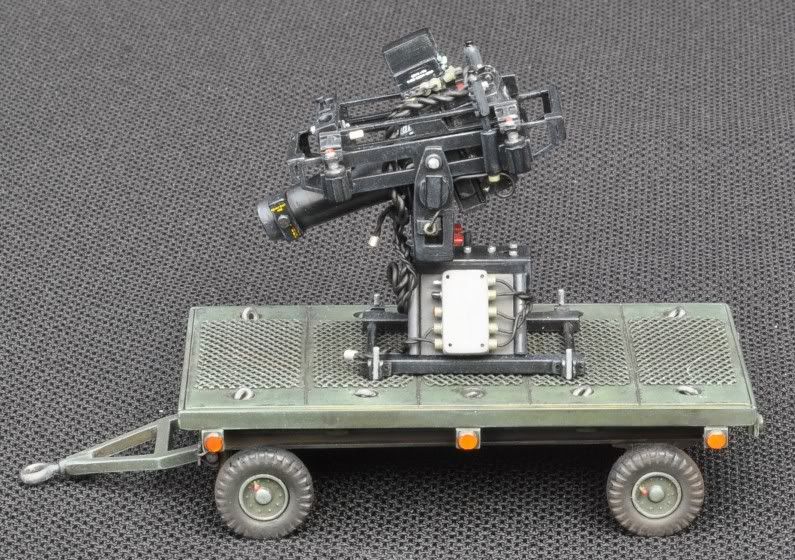
The main reason why it was sent to me is the object on the trailer, this is an F.96 reconnaissance camera and it would have been mounted in the door way of the Puma to take reconnaissance imagery. This camera was designed to fitted in recce aircraft and not Pumas!!
I'm not too sure, but I think the camera and mount were hand-made as I have never seen kits for these.  :-clap :-clap :-clap :-clap

http://img.photobucket.com/albums/v312/matzos/_DSC0045.jpg


http://img.photobucket.com/albums/v312/matzos/_DSC004xx.jpg


http://img.photobucket.com/albums/v312/matzos/_DSC0079.jpg


http://img.photobucket.com/albums/v312/matzos/SensorandTrailer_b_.jpg


http://img.photobucket.com/albums/v312/matzos/SensorandTrailer_l.jpg


Pages: 1 ... 22 23 [24] 25 26 ... 110