


 Show Posts
1831
Aircraft Modeling / January Group Build - MiG-21
« on: January 01, 2012, 03:13:26 PM »
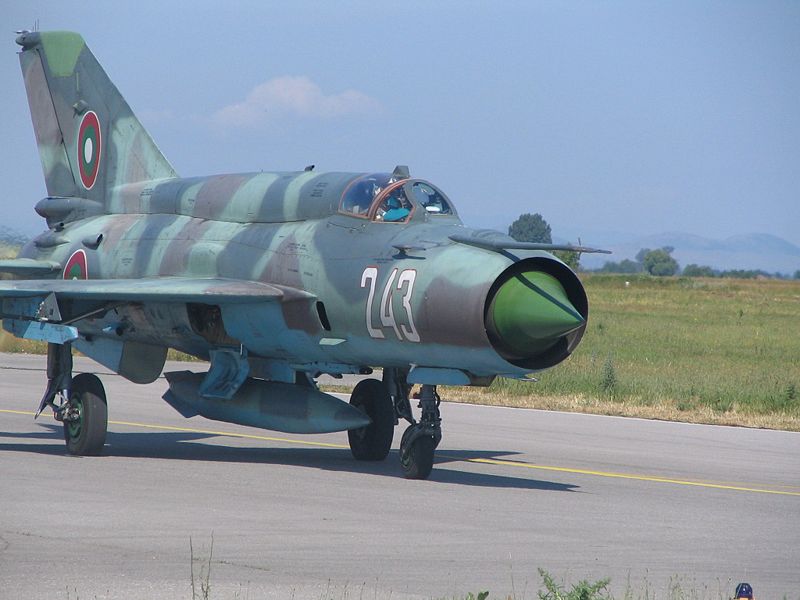
The Mikoyan-Gurevich MiG-21 (Russian: Микоян и Гуревич МиГ-21; NATO reporting name "Fishbed") is a supersonic jet fighter aircraft, designed by the Mikoyan-Gurevich Design Bureau in the Soviet Union. It was popularly nicknamed "balalaika", from the aircraft's planform-view resemblance to the Russian stringed musical instrument or ołówek (English: pencil) by Polish pilots due to the shape of its fuselage. Early versions are considered second-generation jet fighters, while later versions are considered to be third-generation jet fighters. Some 50 countries over four continents have flown the MiG-21, and it still serves many nations a half-century after its maiden flight. The fighter made aviation records. At least by name, it is the most-produced supersonic jet aircraft in aviation history and the most-produced combat aircraft since the Korean War, and it had the longest production run of a combat aircraft (1959 to 1985 over all variants).

Development
The MiG-21 jet fighter was a continuation of Soviet jet fighters, starting with the subsonic MiG-15 and MiG-17, and the supersonic MiG-19. A number of experimental Mach 2 Soviet designs were based on nose intakes with either swept-back wings, such as the Sukhoi Su-7, or tailed deltas, of which the MiG-21 would be the most successful.
Development of what would become the MiG-21 began in the early 1950s, when Mikoyan OKB finished a preliminary design study for a prototype designated Ye-1 in 1954. This project was very quickly reworked when it was determined that the planned engine was underpowered; the redesign led to the second prototype, the Ye-2. Both these and other early prototypes featured swept wings—the first prototype with delta wings as found on production variants was the Ye-4. The Ye-4 made its maiden flight on 16 June 1955 and made its first public appearance during the Soviet Aviation Day display at Moscow's Tushino airfield in July 1956. The MiG-21 was the first successful Soviet aircraft combining fighter and interceptor characteristics in a single aircraft. It was a lightweight fighter, achieving Mach 2 with a relatively low-powered afterburning turbojet, and is thus comparable to the American Lockheed F-104 Starfighter and Northrop F-5 Freedom Fighter and the French Dassault Mirage III. Its basic layout was used for numerous other Soviet designs; delta-winged aircraft included Su-9 interceptor and the fast E-150 prototype from MiG bureau while the mass-produced successful front fighter Su-7 and Mikoyan's I-75 experimental interceptor combined a similar fuselage shape with swept-back wings. However, the characteristic layout with the shock cone and front air intake did not see widespread use outside the USSR and finally proved to have limited development potential, mainly because of the very small space available for the radar.
Like many aircraft designed as interceptors, the MiG-21 had a short range. This was not helped by a design defect where the center of gravity shifted rearwards once two-thirds of the fuel had been used. This had the effect of making the plane uncontrollable, resulting in an endurance of only 45 minutes in clean condition. The issue of the short endurance and low fuel capacity of the MiG-21F, PF, PFM, S/SM and M/MF variants—though each had a somewhat greater fuel capacity than its predecessor—led to the development of the MT and SMT variants. These had a range increase of 250 km (155 mi) compared to the MiG-21SM, but at the cost of worsening all other performance figures (such as a lower service ceiling and slower time to altitude).
The delta wing, while excellent for a fast-climbing interceptor, meant any form of turning combat led to a rapid loss of speed. However, the light loading of the aircraft could mean that a climb rate of 235 m/s (46,250 ft/min) was possible with a combat-loaded MiG-21bis, not far short of the performance of the later F-16A. Given a skilled pilot and capable missiles, it could give a good account of itself against contemporary fighters. It was replaced by the newer variable-geometry MiG-23 and MiG-27 for ground support duties. However, not until the MiG-29 would the Soviet Union ultimately replace the MiG-21 as a maneuvering dogfighter to counter new American air superiority types.
The MiG-21 was exported widely and continues to be used. The aircraft's simple controls, engine, weapons, and avionics were typical of Soviet-era military designs. The use of a tail with the delta wing aids stability and control at the extremes of the flight envelope, enhancing safety for lower-skilled pilots; this in turn enhanced its marketability in exports to developing countries with limited training programs and restricted pilot pools. While technologically inferior to the more advanced fighters it often faced, low production and maintenance costs made it a favorite of nations buying Eastern Bloc military hardware. Several Russian, Israeli and Romanian firms have begun to offer upgrade packages to MiG-21 operators, designed to bring the aircraft up to a modern standard, with greatly upgraded avionics and armaments.
Due to the lack of available information, early details of the MiG-21 were often confused with those of the similar Sukhoi fighters also under development. Jane's All the World's Aircraft 1960–1961 describes the "Fishbed" as a Sukhoi design, and uses an illustration of the Su-9 'Fishpot'.

Production
A total of 10,645 aircraft were built in the USSR. They were produced in three factories: GAZ 30 (3,203 aircraft) in Moscow (also known as Znamya Truda), GAZ 21 (5,765 aircraft)in Gorky and at GAZ 31 (1,678 aircraft) in Tbilisi. Generally, Gorky built single-seaters for the Soviet forces. Moscow built single-seaters for export and Tbilisi manufactured the twin-seaters both for export and for the USSR, though there were exceptions. The MiG-21R and MiG-21bis for export and for the USSR were built in Gorky, 17 single-seaters were built in Tbilisi (MiG-21 and MiG-21F), the MiG-21MF was first built in Moscow and then Gorky, and the MiG-21U was built in Moscow as well as in Tbilisi.
A total of 194 MiG-21F-13s were built under licence in Czechoslovakia, and Hindustan Aeronautics Ltd. of India built 657 MiG-21FL, MiG-21M and MiG-21bis (of which 225 were bis)
Current operators:
Azerbaijan
Bulgaria (photo in flight 2011)
Cambodia
Croatia
Cuba
Egypt
Eritrea
Ethiopia
India
Libya Libyan Republic
Mali
North Korea
Romania
Serbia
Syria
Uganda
Vietnam
Yemen
Zambia
Former operators
Afghanistan
Albania
Algeria
Angola
Bangladesh
Belarus
Burkina Faso
Chad
China (Replaced by similar-looking Chengdu J-7. Other than Mig-21F13 supplied by Soviet Union, China also traded a small amount of Mig-21MFs with J-7 export variations, then developed J-7C/D based on Mig-21MFs. The deal was between China and a certain Middle East country. [48])
Congo, Republic of the
Congo, Democratic Republic of
Czechoslovakia (Passed on to the Czech Republic and Slovakia.)
Czech Republic
East Germany (Passed on to Germany after reunification.)
Finland
Germany
Georgia
Guinea
Guinea-Bissau
Hungary
Indonesia
Iran (Ex-Iraqi MiG-21 received after Iran-Iraq War)
Iraq (As of Saddam's Era)
Israel (Captured from Syria and Egypt)
Kyrgyzstan (Still houses some 100 partly dismantled fighters.)
Laos
Libya (As of Gaddafi's Era)
Madagascar
Mongolia
Mozambique
Namibia
Nigeria
Poland
Russia
Slovakia
Somalia
Soviet Union (Passed on to successor states.)
Sudan
Tanzania
Turkmenistan
United States (Evaluation only.)
Ukraine
North Yemen (Passed on to Yemen after reunification.)
South Yemen (Passed on to Yemen after reunification.)
Yugoslavia (Passed on to successor states.)
Zaire (Four were exported to Zairean rebels by FR Yugoslavia [49]
Zimbabwe
Development
The MiG-21 jet fighter was a continuation of Soviet jet fighters, starting with the subsonic MiG-15 and MiG-17, and the supersonic MiG-19. A number of experimental Mach 2 Soviet designs were based on nose intakes with either swept-back wings, such as the Sukhoi Su-7, or tailed deltas, of which the MiG-21 would be the most successful.
Development of what would become the MiG-21 began in the early 1950s, when Mikoyan OKB finished a preliminary design study for a prototype designated Ye-1 in 1954. This project was very quickly reworked when it was determined that the planned engine was underpowered; the redesign led to the second prototype, the Ye-2. Both these and other early prototypes featured swept wings—the first prototype with delta wings as found on production variants was the Ye-4. The Ye-4 made its maiden flight on 16 June 1955 and made its first public appearance during the Soviet Aviation Day display at Moscow's Tushino airfield in July 1956. The MiG-21 was the first successful Soviet aircraft combining fighter and interceptor characteristics in a single aircraft. It was a lightweight fighter, achieving Mach 2 with a relatively low-powered afterburning turbojet, and is thus comparable to the American Lockheed F-104 Starfighter and Northrop F-5 Freedom Fighter and the French Dassault Mirage III. Its basic layout was used for numerous other Soviet designs; delta-winged aircraft included Su-9 interceptor and the fast E-150 prototype from MiG bureau while the mass-produced successful front fighter Su-7 and Mikoyan's I-75 experimental interceptor combined a similar fuselage shape with swept-back wings. However, the characteristic layout with the shock cone and front air intake did not see widespread use outside the USSR and finally proved to have limited development potential, mainly because of the very small space available for the radar.
Like many aircraft designed as interceptors, the MiG-21 had a short range. This was not helped by a design defect where the center of gravity shifted rearwards once two-thirds of the fuel had been used. This had the effect of making the plane uncontrollable, resulting in an endurance of only 45 minutes in clean condition. The issue of the short endurance and low fuel capacity of the MiG-21F, PF, PFM, S/SM and M/MF variants—though each had a somewhat greater fuel capacity than its predecessor—led to the development of the MT and SMT variants. These had a range increase of 250 km (155 mi) compared to the MiG-21SM, but at the cost of worsening all other performance figures (such as a lower service ceiling and slower time to altitude).
The delta wing, while excellent for a fast-climbing interceptor, meant any form of turning combat led to a rapid loss of speed. However, the light loading of the aircraft could mean that a climb rate of 235 m/s (46,250 ft/min) was possible with a combat-loaded MiG-21bis, not far short of the performance of the later F-16A. Given a skilled pilot and capable missiles, it could give a good account of itself against contemporary fighters. It was replaced by the newer variable-geometry MiG-23 and MiG-27 for ground support duties. However, not until the MiG-29 would the Soviet Union ultimately replace the MiG-21 as a maneuvering dogfighter to counter new American air superiority types.
The MiG-21 was exported widely and continues to be used. The aircraft's simple controls, engine, weapons, and avionics were typical of Soviet-era military designs. The use of a tail with the delta wing aids stability and control at the extremes of the flight envelope, enhancing safety for lower-skilled pilots; this in turn enhanced its marketability in exports to developing countries with limited training programs and restricted pilot pools. While technologically inferior to the more advanced fighters it often faced, low production and maintenance costs made it a favorite of nations buying Eastern Bloc military hardware. Several Russian, Israeli and Romanian firms have begun to offer upgrade packages to MiG-21 operators, designed to bring the aircraft up to a modern standard, with greatly upgraded avionics and armaments.
Due to the lack of available information, early details of the MiG-21 were often confused with those of the similar Sukhoi fighters also under development. Jane's All the World's Aircraft 1960–1961 describes the "Fishbed" as a Sukhoi design, and uses an illustration of the Su-9 'Fishpot'.
Production
A total of 10,645 aircraft were built in the USSR. They were produced in three factories: GAZ 30 (3,203 aircraft) in Moscow (also known as Znamya Truda), GAZ 21 (5,765 aircraft)in Gorky and at GAZ 31 (1,678 aircraft) in Tbilisi. Generally, Gorky built single-seaters for the Soviet forces. Moscow built single-seaters for export and Tbilisi manufactured the twin-seaters both for export and for the USSR, though there were exceptions. The MiG-21R and MiG-21bis for export and for the USSR were built in Gorky, 17 single-seaters were built in Tbilisi (MiG-21 and MiG-21F), the MiG-21MF was first built in Moscow and then Gorky, and the MiG-21U was built in Moscow as well as in Tbilisi.
A total of 194 MiG-21F-13s were built under licence in Czechoslovakia, and Hindustan Aeronautics Ltd. of India built 657 MiG-21FL, MiG-21M and MiG-21bis (of which 225 were bis)
Current operators:
Azerbaijan
Bulgaria (photo in flight 2011)
Cambodia
Croatia
Cuba
Egypt
Eritrea
Ethiopia
India
Libya Libyan Republic
Mali
North Korea
Romania
Serbia
Syria
Uganda
Vietnam
Yemen
Zambia
Former operators
Afghanistan
Albania
Algeria
Angola
Bangladesh
Belarus
Burkina Faso
Chad
China (Replaced by similar-looking Chengdu J-7. Other than Mig-21F13 supplied by Soviet Union, China also traded a small amount of Mig-21MFs with J-7 export variations, then developed J-7C/D based on Mig-21MFs. The deal was between China and a certain Middle East country. [48])
Congo, Republic of the
Congo, Democratic Republic of
Czechoslovakia (Passed on to the Czech Republic and Slovakia.)
Czech Republic
East Germany (Passed on to Germany after reunification.)
Finland
Germany
Georgia
Guinea
Guinea-Bissau
Hungary
Indonesia
Iran (Ex-Iraqi MiG-21 received after Iran-Iraq War)
Iraq (As of Saddam's Era)
Israel (Captured from Syria and Egypt)
Kyrgyzstan (Still houses some 100 partly dismantled fighters.)
Laos
Libya (As of Gaddafi's Era)
Madagascar
Mongolia
Mozambique
Namibia
Nigeria
Poland
Russia
Slovakia
Somalia
Soviet Union (Passed on to successor states.)
Sudan
Tanzania
Turkmenistan
United States (Evaluation only.)
Ukraine
North Yemen (Passed on to Yemen after reunification.)
South Yemen (Passed on to Yemen after reunification.)
Yugoslavia (Passed on to successor states.)
Zaire (Four were exported to Zairean rebels by FR Yugoslavia [49]
Zimbabwe


